
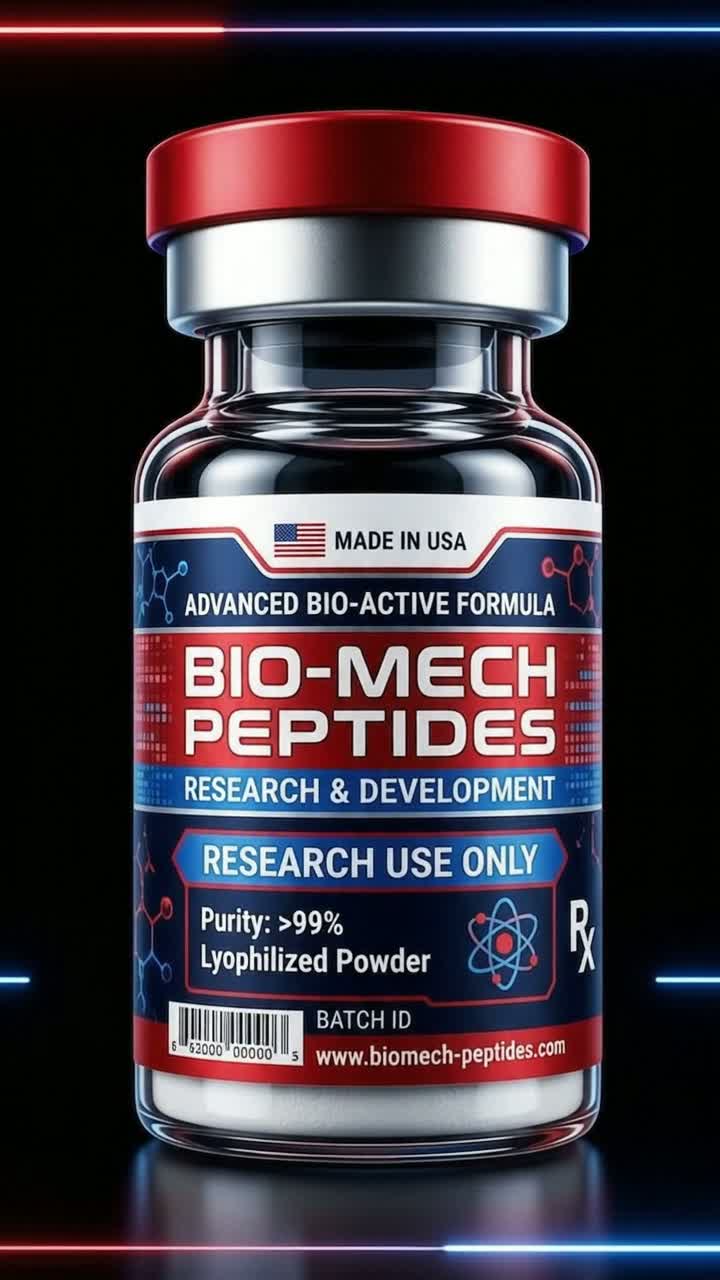
Academy · Beginner
What Are Research Peptides?
A plain-English primer on research peptides: what they are, how they differ from clinical-grade compounds, and how scientists actually use them.
What is a peptide, really?
A peptide is a short chain of amino acids — the same building blocks proteins are made of, just smaller. Most research peptides fall between 2 and 50 amino acids long. Anything longer is usually called a protein.
Because they're short, peptides can be chemically synthesised at scale with high purity and precise sequence control. That's why a vial of research-grade BPC-157 from one batch should be molecularly identical to a vial from a different batch made the same way.
Research-grade vs clinical-grade
Clinical-grade compounds are manufactured under cGMP for use in humans and shipped with regulatory dossiers. Research-grade compounds — what we sell — are manufactured to the same chemical specifications but supplied only for in-vitro and laboratory characterisation work.
The molecule on the label is the same; the regulatory framework around it is not. That's why labels say 'for research use only' and why we publish COAs rather than package inserts.
What do scientists actually do with them?
Reference standard work (chromatogram matching, retention time calibration), in-vitro receptor binding assays, cell-culture exposure studies, stability work in different buffers, formulation R&D for academic groups, and benchmarking against newly synthesised analogues.
Legality & framing
Research peptides may generally be imported for laboratory research in most jurisdictions, but they are not approved for human or veterinary use. Always check your local rules before ordering.
How a peptide reaches a laboratory bench
The route from synthesis to bench is shorter than most researchers expect. Solid-phase synthesis produces the raw sequence; purification runs through preparative chromatography; and an analytical certificate documents what the finished material actually is. Between synthesis and the vial, the only parties that matter are the manufacturing site and the independent laboratory that verifies the batch — everything else is logistics.
That short chain is also why verification matters so much in this market. With no regulatory dossier standing between manufacture and dispatch, the batch certificate is the single documented control point. A supplier either publishes it, batch by batch, or asks researchers to take the label on trust.
Lyophilisation is the final step and the one researchers interact with most. Freeze-drying removes water under vacuum, leaving a stable powder that tolerates ambient-temperature transit far better than a solution would. Reconstitution happens at the bench, not in the warehouse — which is why the certificate lists water content as a measured value rather than assuming it away.
What separates a useful reference supplier from noise
Three signals do most of the work. First, verifiable testing: the certificate must name the laboratory, carry a signature and date, and correspond to the batch number on the vial — not a representative batch from a different production run. Second, published history: suppliers that keep historical certificates online after a batch sells out are demonstrating that the documentation was real when it was issued. Third, specificity: 'lab-tested' means nothing; '99.2% HPLC main peak, mass-spec MW 4,647.5 Da, batch 2509-RX14' can be checked line by line.
Price is a weak signal in both directions. Underpricing usually tracks with skipped verification; overpricing tracks with marketing spend, not better molecules. What tracks with quality is process: lot-matched kits, batch traceability, and answers to technical questions that read like they were written by someone who has read the certificate.
The practical test before ordering anything: search the supplier's COA library for the exact compound and batch. If the library is searchable, dated and signed, the rest of the listing deserves the benefit of the doubt. If it isn't, the listing doesn't.
Frequently asked questions
Are research peptides the same as medical peptides?+
Chemically yes; regulatorily no. Research peptides are not approved for human use and are sold strictly for laboratory research.
Why are they cheaper than pharmacy versions?+
There's no clinical packaging, patient leaflet, distribution licensing or regulatory dossier in the price.
Do research peptides expire?+
Lyophilised peptide powder is chemically stable for years when stored correctly — sealed, dry, away from light, ideally refrigerated. Stability is a function of storage conditions and the specific sequence, not a fixed calendar date.
Are all research peptides white powder?+
Most are, but appearance is not a quality signal. Some sequences carry visible colour from their chemistry (copper-binding compounds, for example). A colourless powder proves nothing; the certificate does.
Related reading
Order in 3 steps · tracked delivery
Order research peptides for your laboratory
Batch documentation is provided on request — no laboratory reports have yet been verified for publication against Bio Mech stock. Dispatch is tracked on every order; allow 5–18 business days once tracking is active. Supplied for in-vitro research use only.
- 1
Choose your compound
Browse the catalog or search for a specific reference standard.
- 2
Checkout in 2 minutes
Bank transfer or card — the full price is shown before you pay.
- 3
Tracked dispatch
Tracking on every order; 5–18 business days once tracking is active.
Most ordered this month
BPC-157
From €269.00
Ipamorelin
From €249.00
Bacteriostatic Water
From €149.00
- Research use only — not for human consumption
- Tracked delivery to the USA, UK, Europe and the Middle East
- Batch documentation available on request
Research materials · Order information
Research only
Not for human consumption
Documentation
Ask about the specific batch
Tracked parcels
5–18 business days
Tracked Delivery
5–18 business days
Pay with Wise, Revolut, Monzo, bunq or bank transfer
- Card via Wise
- Card via Revolut
- Bank Transfer