
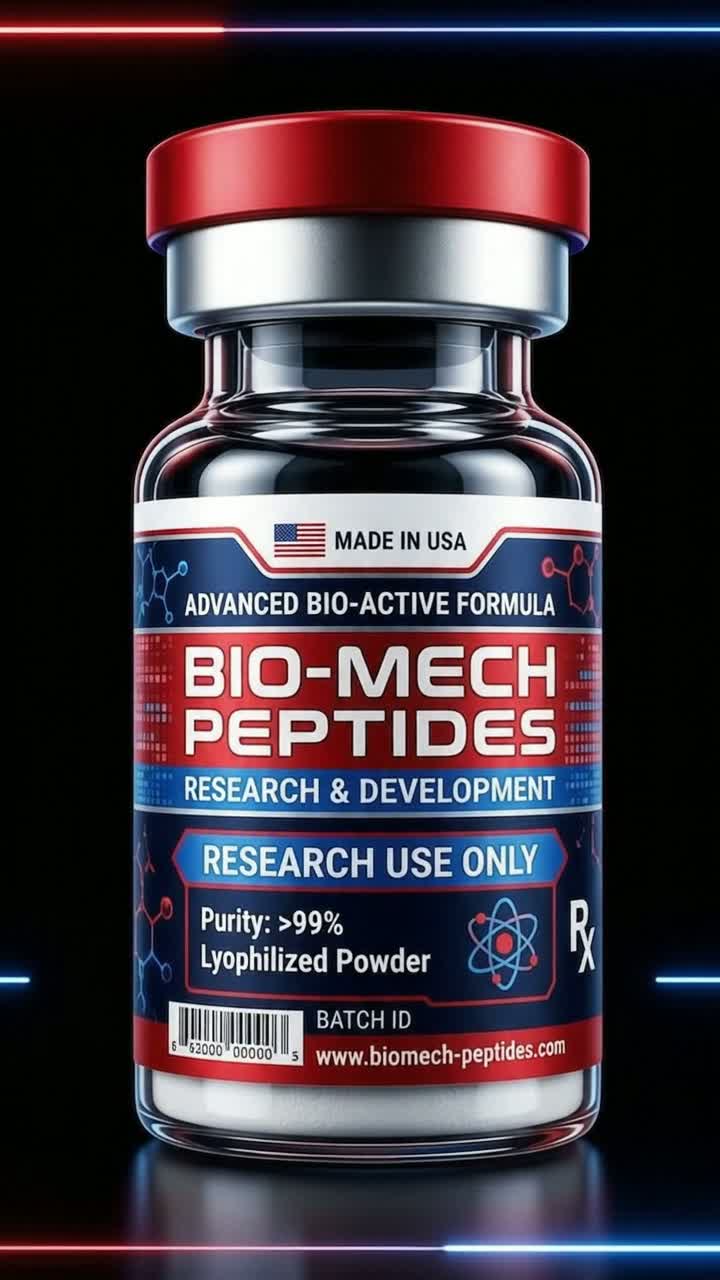
Hub · GHK-Cu
GHK-Cu Research Reference: Copper Peptide Overview | Bio Mech
GHK-Cu is a copper-bound tripeptide widely studied in regenerative-research literature. This reference covers handling and batch verification.
Reading this research reference
The information below concerns the research subject, not proof of the identity or performance of a supplied material. Check the original sources and your laboratory’s requirements; product documentation must be assessed separately for the exact batch.
What GHK-Cu is
GHK-Cu is the copper complex of the glycyl-histidyl-lysine tripeptide. It appears across regenerative and dermal-research literature for its copper-binding profile.
Handling notes
Lyophilised storage at 2–8°C, reconstitution with bacteriostatic water and refrigerated in-use storage are standard. Protect from prolonged light exposure.
Batch verification
HPLC purity and identity confirmation accompany every Bio Mech batch — see the lab reports page.
The chemistry that makes GHK-Cu unusual
GHK is a tripeptide — glycyl-histidyl-lysine — whose histidine imidazole binds copper(II) with high affinity, forming the GHK-Cu complex. That binding is not incidental: the copper centre is the biologically interesting part of the molecule, and most of the published research on wound-healing, dermal-remodelling and gene-expression modulation centres on the complex rather than the free tripeptide.
The complex's chemistry also drives its handling profile. GHK-Cu solutions are visibly blue — a genuine property of the copper complex, and one of the rare cases where appearance carries real information. Colour intensity that looks wrong for the stated concentration can indicate degradation or concentration error, which is why the reference literature treats the blue tone as an informal check rather than a quality certificate.
Oxidation state matters in research use: the complex can shift between copper(II) and copper(I) forms, and reducing environments change its behaviour. Protocols that care about this detail buffer and deoxygenate accordingly; protocols that don't should at least record which state their preparation reflects.
Research directions in the GHK-Cu literature
Three threads dominate the published work. Dermal and connective-tissue research studies the complex's effects on collagen and glycosaminoglycan synthesis in fibroblast models. Wound-healing research examines angiogenesis and inflammatory modulation in repair models. And gene-expression profiling — largely from the work of Loren Pickart and collaborators — catalogues the broad set of genes whose expression shifts in GHK-Cu-treated fibroblasts, a dataset that has fed both cosmetic-research and basic-biology interpretations.
What the literature does not establish is equally relevant: most of the evidence base is in-vitro and animal-model work, with limited human clinical literature at research-grade purity standards. Researchers designing new work therefore treat GHK-Cu as a hypothesis-generating compound — well characterised chemically, actively studied, and far from a settled question mechanistically.
Verification specifics for copper peptides
Copper complexes add a wrinkle to standard verification: the certificate needs to confirm the complex, not just the peptide. HPLC traces for GHK-Cu show characteristic behaviour, and identity confirmation by mass spectrometry must account for the copper mass — a spectrum that only shows the free tripeptide indicates dissociation rather than the intact complex.
For sourcing, the practical checks are the same as any compound — lot-matched certificate, named independent laboratory, measured values rather than ranges — plus one GHK-specific question: does the documentation describe the material as the copper complex with its characteristic properties, and does the batch's analytical profile match that description? Suppliers who have verified the actual shipped form can answer it from the certificate; suppliers who cannot, are selling a label.
Frequently asked questions
What strengths are available?+
See the GHK-Cu entry in the Peptide Library for current strengths and pricing.
Is GHK-Cu the same as GHK?+
No. GHK is the free tripeptide; GHK-Cu is its copper complex. The published research on dermal and regenerative effects concerns the copper complex specifically.
Why is my GHK-Cu solution blue?+
The blue colour is a genuine property of the copper complex at typical concentrations. It is an informal indicator of the complex's presence, not a substitute for batch verification.
Does GHK-Cu need light protection?+
Prolonged light exposure is worth avoiding for copper-peptide solutions, as with most peptide stocks. Refrigerated, capped, opaque storage is standard practice.
GHK-Cu on Bio Mech
Product details, batch documentation and support for the compound discussed above. Research use only.
Continue your research
Research compounds overview
Laboratory peptides guide
Storage & reconstitution guide
Peptide glossary
Peptide Library
Browse the full HPLC-verified catalogue
Buy in Marbella
Tracked Costa del Sol delivery
Book a free consultation
20-minute call with the Bio Mech team
Lab reports & COAs
Batch-by-batch purity certificates
Order in 3 steps · tracked delivery
Order research peptides for your laboratory
Batch documentation is provided on request — no laboratory reports have yet been verified for publication against Bio Mech stock. Dispatch is tracked on every order; allow 5–18 business days once tracking is active. Supplied for in-vitro research use only.
- 1
Choose your compound
Browse the catalog or search for a specific reference standard.
- 2
Checkout in 2 minutes
Bank transfer or card — the full price is shown before you pay.
- 3
Tracked dispatch
Tracking on every order; 5–18 business days once tracking is active.
Most ordered this month
BPC-157
From €269.00
Ipamorelin
From €249.00
Bacteriostatic Water
From €149.00
- Research use only — not for human consumption
- Tracked delivery to the USA, UK, Europe and the Middle East
- Batch documentation available on request
Research materials · Order information
Research only
Not for human consumption
Documentation
Ask about the specific batch
Tracked parcels
5–18 business days
Tracked Delivery
5–18 business days
Pay with Wise, Revolut, Monzo, bunq or bank transfer
- Card via Wise
- Card via Revolut
- Bank Transfer