
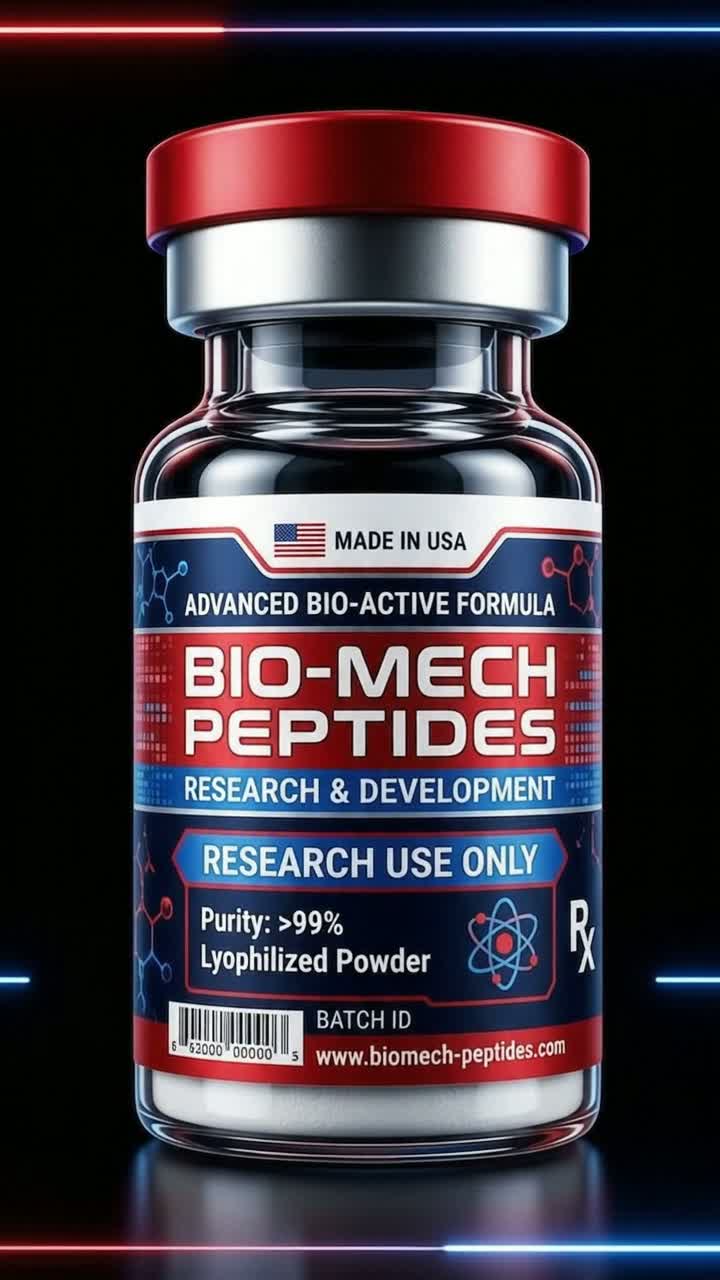
Thymosin family comparison
TB-500 vs Thymosin Alpha-1: Research Comparison | Bio Mech
TB-500 (thymosin beta-4 active fragment) and Thymosin Alpha-1 are both thymosin-family research peptides, but they act on completely different axes. TB-500 acts on the actin-binding / tissue-remodelling axis; Thymosin Alpha-1 acts on the immunomodulatory / T-cell axis. This page lays out the side-by-side detail for laboratory and preclinical research.
Reading this research reference
The information below concerns the research subject, not proof of the identity or performance of a supplied material. Check the original sources and your laboratory’s requirements; product documentation must be assessed separately for the exact batch.
Mechanism — how TB-500 and Thymosin Alpha-1 differ
TB-500 is a synthetic peptide based on the active region of thymosin beta-4 (Tβ4). Its proposed research mechanism centres on the actin-binding axis — actin sequestration and downstream effects on cell migration, angiogenesis and tissue remodelling.
Thymosin Alpha-1 (Tα1) is a 28-amino-acid peptide derived from prothymosin-α. Its proposed research mechanism centres on T-cell axis modulation — enhancement of T-cell maturation and downstream immune-response signalling in preclinical models.
Receptor profile
TB-500 acts through the thymosin-β4 actin-binding axis rather than a conventional cell-surface receptor.
Thymosin Alpha-1 acts via Toll-like receptor pathways (TLR2 / TLR9) in the immune-axis research literature, with downstream effects on T-cell differentiation and cytokine-response programmes.
Research applications
TB-500 is used in research models of cell migration, wound healing, angiogenesis and tissue remodelling.
Thymosin Alpha-1 is used in research models of immune-response modulation, T-cell axis studies, viral-response research and adjuvant immune-axis work.
Analytical specification on every Bio Mech batch
Both TB-500 and Thymosin Alpha-1 ship from Bio Mech only after independent third-party verification — Janoshik Analytical is the default verifier, with orthogonal independent laboratories used when batch chemistry calls for confirmation by a second method. Minimum release specification is ≥99.0% HPLC main-peak purity with matching mass-spectrometry molecular weight and water content within the published specification for the compound.
Batch COAs for both compounds are published on the Bio Mech lab reports page so a research-peptide buyer can audit the analytical detail before purchase. The /trust/how-to-read-a-coa reference walks through every field on a modern Bio Mech COA.
Handling, reconstitution and stability
Both compounds ship lyophilised under nitrogen. Hold the unopened vial at 2–8 °C; freeze at −20 °C for long-term storage. Reconstitution with bacteriostatic water (0.9% benzyl alcohol) supports a two-month (60-day) in-use stability window under refrigeration for both compounds.
Aliquot before any freeze. The single most common cause of measurable potency loss in research peptides is repeat freeze-thaw cycling — both TB-500 and Thymosin Alpha-1 benefit from single-thaw aliquot workflows. Vortex gently, never shake aggressively, and keep reconstituted vials away from direct light. The /research/compound-storage-guide reference covers the per-compound stability windows in detail.
When researchers choose TB-500 vs Thymosin Alpha-1
Researchers choose TB-500 when the protocol targets the tissue-repair / actin-binding axis — cell migration, wound-healing, angiogenesis. Researchers choose Thymosin Alpha-1 when the protocol targets the immunomodulatory / T-cell axis. The two are complementary rather than substitutable — comparator studies sometimes include both to characterise thymosin-family effects across two independent research axes.
For multi-compound comparator studies, the Bio Mech consultations team will reserve matched-batch inventory of both TB-500 and Thymosin Alpha-1 against a project timeline so the experimental panel is sourced under a single analytical specification window.
Regulatory and research-use framing
Both TB-500 and Thymosin Alpha-1 are supplied strictly for in-vitro and preclinical research use. They are not medicines, are not approved for human consumption in Spain, the United Kingdom, the European Union or the United States, and are not dispensed against a prescription. Ask support about documentation for the specific batch.
Comparison pages on the Bio Mech site exist for laboratory-research reference. Nothing on this page constitutes a recommendation for human use of either compound.
Frequently asked questions
What is the main difference between TB-500 and Thymosin Alpha-1?+
TB-500 is a synthetic peptide based on the active region of thymosin beta-4 (Tβ4).
Are TB-500 and Thymosin Alpha-1 the same compound class?+
Both sit in the thymosin-family research peptides category but with distinct receptor profiles and pharmacokinetics — see the receptor-profile section above for the side-by-side detail.
What HPLC purity does Bio Mech release each compound against?+
≥99.0% HPLC main-peak purity for both TB-500 and Thymosin Alpha-1, with matching mass-spectrometry molecular weight and water content within the published specification for each compound.
Who independently verifies the batches?+
Janoshik Analytical is the default independent verifier for both compounds; orthogonal independent laboratories are used when batch chemistry calls for second-method confirmation.
Can I order matched batches for a comparator study?+
Yes — the Bio Mech consultations team will reserve matched-batch inventory of both compounds against a project timeline so the experimental panel is sourced under a single analytical specification window.
Are these peptides approved for human use?+
No. Both are supplied strictly for in-vitro and preclinical research use. They are not medicines, are not approved for human consumption, and are not dispensed against a prescription.
Where can I see the current batch COAs for both compounds?+
On the /coa lab reports page, indexed by compound and batch number. New batches appear within 24 hours of independent release.
Thymosin Alpha-1 vs TB-500 (Thymosin Beta-4) on Bio Mech
Product details, batch documentation and support for the compounds discussed above. Research use only.
Continue your research
Order in 3 steps · tracked delivery
Order research peptides for your laboratory
Batch documentation is provided on request — no laboratory reports have yet been verified for publication against Bio Mech stock. Dispatch is tracked on every order; allow 5–18 business days once tracking is active. Supplied for in-vitro research use only.
- 1
Choose your compound
Browse the catalog or search for a specific reference standard.
- 2
Checkout in 2 minutes
Bank transfer or card — the full price is shown before you pay.
- 3
Tracked dispatch
Tracking on every order; 5–18 business days once tracking is active.
Most ordered this month
BPC-157
From €269.00
Ipamorelin
From €249.00
Bacteriostatic Water
From €149.00
- Research use only — not for human consumption
- Tracked delivery to the USA, UK, Europe and the Middle East
- Batch documentation available on request
Research materials · Order information
Research only
Not for human consumption
Documentation
Ask about the specific batch
Tracked parcels
5–18 business days
Tracked Delivery
5–18 business days
Pay with Wise, Revolut, Monzo, bunq or bank transfer
- Card via Wise
- Card via Revolut
- Bank Transfer