
Hub · BPC-157
BPC-157 Research Reference: Mechanisms & Literature | Bio Mech
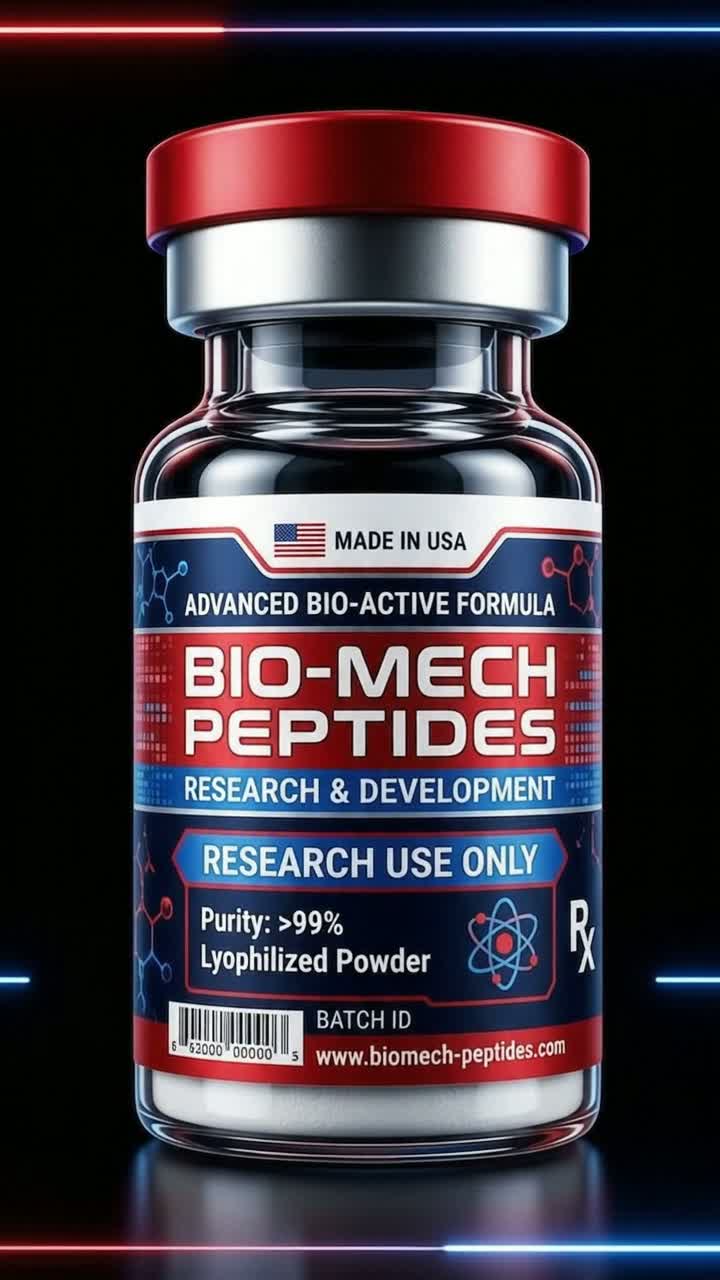
BPC-157 is a 15-amino-acid synthetic peptide studied in regenerative-research literature. This reference covers handling and batch verification.
Reading this research reference
The information below concerns the research subject, not proof of the identity or performance of a supplied material. Check the original sources and your laboratory’s requirements; product documentation must be assessed separately for the exact batch.
Sequence background
BPC-157 is a stable synthetic fragment derived from a sequence first characterised in gastric-juice research literature.
Handling
Lyophilised storage at 2–8°C, reconstitution with bacteriostatic water and refrigerated in-use storage are standard.
Batch documentation
HPLC purity and identity confirmation accompany every Bio Mech batch on the lab reports page.
Why BPC-157 dominates the regenerative-research conversation
Part of the compound's research profile is structural: a short, stable 15-residue sequence is far easier to synthesise, purify and verify than the long, aggregation-prone chains that dominate the growth-hormone axis. That stability shows up in practice — lyophilised BPC-157 tolerates normal handling and ambient-temperature transit without the sensitivity issues some larger sequences exhibit.
The other part is literature volume. BPC-157 has been the subject of a large body of published research across tissue-repair models, angiogenesis signalling and organ-protective studies, which makes it one of the most-cited compounds in the regenerative category. Volume of literature does not settle mechanism — but it does mean researchers can usually find prior work to benchmark their own protocols against, which is exactly what a reference supplier should enable.
A practical consequence for sourcing: because demand is high and synthesis is well-understood, the quality spread between suppliers is driven almost entirely by verification discipline rather than chemistry. Two vials of identical sequence can differ meaningfully in what is documented about them — which is why the batch certificate, not the compound name, is the unit of quality.
What a careful laboratory checks before opening a vial
Before a vial enters a protocol, three checks close most of the common failure modes. First, match the batch: the lot number printed on the vial label should correspond to a published, dated certificate — not to a representative document or a different production run. Second, check identity and purity pair: the HPLC main-peak percentage and the mass-spec molecular weight should both be present, because either alone is blind to the other's failure mode. Third, confirm the physical state: the lyophilised cake should be intact, dry and free of visible discoloration or clumping that suggests moisture exposure.
If any of the three checks fails, the right next step is documentation, not improvisation: photograph the vial and label, note the discrepancy, and contact the supplier's technical channel. Suppliers with real batch systems can trace a discrepancy to its production record quickly; suppliers without one cannot, which is itself useful information.
BPC-157 in context: where it sits in the catalogue
BPC-157 anchors the regenerative category, but it is rarely the only compound a laboratory evaluates. Adjacent references include TB-500 (actin-binding, cytoskeletal research), KPV (an anti-inflammatory-active fragment studied in epithelial models) and GHK-Cu (copper-binding dermal research). Each targets a different layer of tissue-remodelling biology, and the reference guides for each cover their own handling and documentation profile.
For protocols comparing compounds, the practical starting points are the BPC-157 vs TB-500 comparison and the KPV vs BPC-157 comparison — both cover sequence background, proposed pathways and verification practice side by side, in the same research-only framing as this guide.
Frequently asked questions
Is BPC-157 in stock?+
Check the BPC-157 entry in the Peptide Library for current availability.
Is BPC-157 the same as TB-500?+
No — they are distinct synthetic peptides with different sequences, molecular weights and research literature. See the dedicated comparison guide for the side-by-side.
Does BPC-157 require special handling?+
Standard lyophilised-peptide practice applies: 2–8°C storage, gentle reconstitution with bacteriostatic water, refrigerated in-use storage. It is among the more handling-tolerant sequences in the catalogue.
Where is BPC-157 research published?+
The primary literature is indexed on PubMed; a curated starting point is the outbound reference links on this page and on the BPC-157 product page.
BPC-157 on Bio Mech
Product details, batch documentation and support for the compound discussed above. Research use only.
Continue your research
Research compounds overview
Laboratory peptides guide
Storage & reconstitution guide
Peptide glossary
Peptide Library
Browse the full HPLC-verified catalogue
Buy in Marbella
Tracked Costa del Sol delivery
Book a free consultation
20-minute call with the Bio Mech team
Lab reports & COAs
Batch-by-batch purity certificates
Order in 3 steps · tracked delivery
Order research peptides for your laboratory
Batch documentation is provided on request — no laboratory reports have yet been verified for publication against Bio Mech stock. Dispatch is tracked on every order; allow 5–18 business days once tracking is active. Supplied for in-vitro research use only.
- 1
Choose your compound
Browse the catalog or search for a specific reference standard.
- 2
Checkout in 2 minutes
Bank transfer or card — the full price is shown before you pay.
- 3
Tracked dispatch
Tracking on every order; 5–18 business days once tracking is active.
Most ordered this month
BPC-157
From €269.00
Ipamorelin
From €249.00
Bacteriostatic Water
From €149.00
- Research use only — not for human consumption
- Tracked delivery to the USA, UK, Europe and the Middle East
- Batch documentation available on request
Research materials · Order information
Research only
Not for human consumption
Documentation
Ask about the specific batch
Tracked parcels
5–18 business days
Tracked Delivery
5–18 business days
Pay with Wise, Revolut, Monzo, bunq or bank transfer
- Card via Wise
- Card via Revolut
- Bank Transfer