
Hub · Guide
Laboratory Peptides: Practical Research Guide | Bio Mech
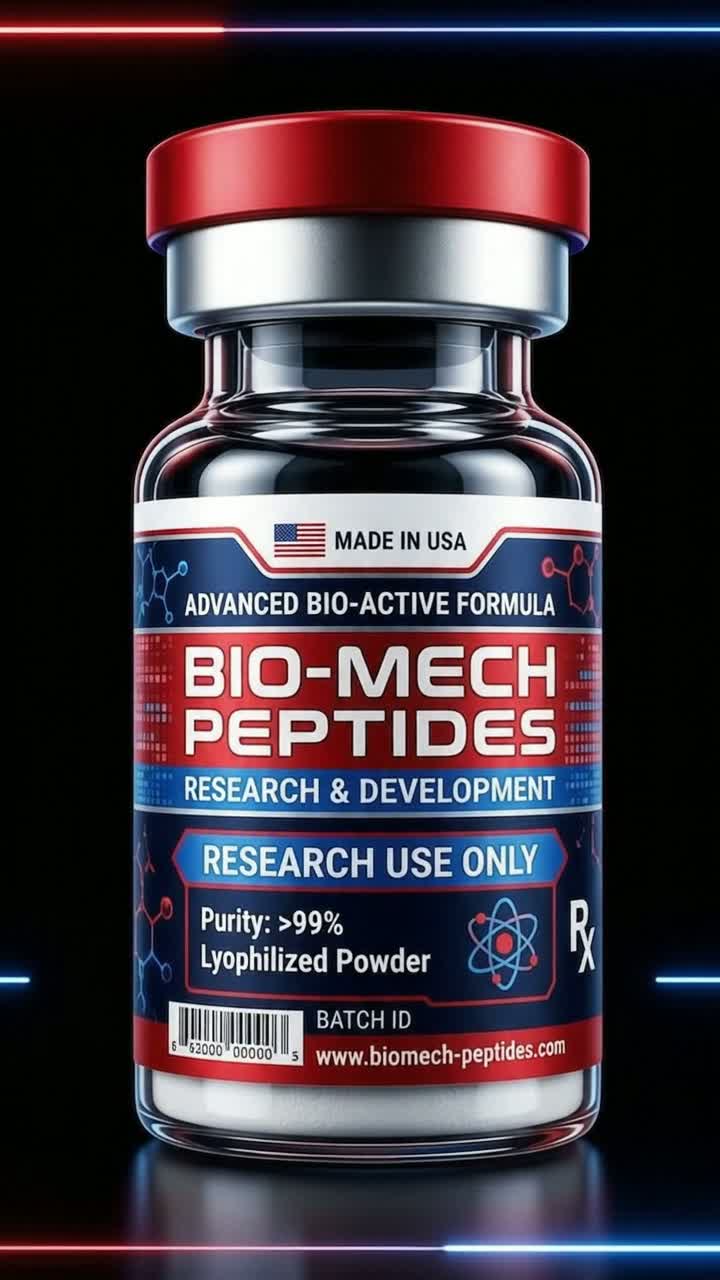
A practical guide to handling lyophilised research peptides — covering reconstitution, storage, in-use stability and basic assay considerations.
Reading this research reference
The information below concerns the research subject, not proof of the identity or performance of a supplied material. Check the original sources and your laboratory’s requirements; product documentation must be assessed separately for the exact batch.
Reconstitution basics
Most lyophilised peptides reconstitute with bacteriostatic water. Add solvent slowly down the vial wall; swirl, do not shake. Avoid direct contact with the lyophilised cake.
Cold chain
Lyophilised storage at 2–8°C is standard. Long-term archive storage may use −20°C. Reconstituted product stays refrigerated and is used within the COA's stated window.
Assay considerations
Peptide content (not just mass) drives quantitative accuracy. Cross-reference the COA's peptide-content figure when preparing working stocks.
Setting up a peptide bench: the equipment that actually matters
Peptide work does not demand a large capital outlay, but a few items earn their place immediately. A calibrated 0.5–1 ml syringe set covers nearly all drawing tasks at research scales; an accurate 0.001 g scale is optional but useful for mass checks; a fridge thermometer confirms the 2–8°C claim rather than assuming it; and a sealed secondary container with desiccant converts an ordinary freezer into adequate peptide storage. Sterile consumables — needles, vials, aliquot tubes — are bought in quantity because per-use cost is trivial and running out mid-protocol is expensive.
What the list deliberately omits: expensive analytical instruments are the supplier's responsibility, not the receiving lab's. The laboratory's job is to handle verified material correctly, not to re-verify it — which is why batch documentation accompanies every vial rather than every lab investing in HPLC.
Peptide content versus gross mass
A vial labelled 5 mg contains 5 mg of material, but the fraction that is actual peptide depends on the batch: salts from the counter-ion, residual water from lyophilisation and trace impurities all occupy mass. The certificate's peptide-content figure — typically expressed as a percentage or net peptide amount — is the number that quantitative work needs, and the difference between nominal mass and net peptide can be several percent.
The practical habit: when preparing working stocks, read the certificate's net content and calculate from that, not the label. Over a multi-protocol study, the compounding difference between nominal and net values is one of the quiet sources of inter-batch variability that shows up as unexplained scatter.
Record-keeping that pays for itself
Three records convert a peptide bench from informal to auditable, and none requires software. An inventory log — compound, batch, arrival date, location — answers 'what do we have' instantly. A usage log — which protocol drew from which vial, when — traces anomalies back to their source material. And a certificate archive, kept per batch, makes every stored vial verifiable years later.
The moment this investment pays back is always unplanned: a collaborator inherits the bench, a result needs tracing, or a grant reviewer asks about material provenance. Labs with the three records answer in minutes; labs without them reconstruct from memory and hope.
Frequently asked questions
Can I freeze reconstituted peptide?+
Some peptides tolerate a single freeze-thaw cycle; many do not. Defer to the COA and your internal SOP.
Do I need to sterilise peptide vials before use?+
The vial exterior and your work surface should be clean; the septum is disinfected before each entry. Research-grade material itself is not sterile-certified unless the documentation states sterility testing.
How do I know my fridge is actually 2–8°C?+
A small fridge thermometer placed with the vials — not on the door — settles it. Door shelves cycle warmest and are best avoided for peptide storage.
Continue your research
Research compounds overview
Laboratory peptides guide
Storage & reconstitution guide
Peptide glossary
Peptide Library
Browse the full HPLC-verified catalogue
Buy in Marbella
Tracked Costa del Sol delivery
Book a free consultation
20-minute call with the Bio Mech team
Lab reports & COAs
Batch-by-batch purity certificates
Order in 3 steps · tracked delivery
Order research peptides for your laboratory
Batch documentation is provided on request — no laboratory reports have yet been verified for publication against Bio Mech stock. Dispatch is tracked on every order; allow 5–18 business days once tracking is active. Supplied for in-vitro research use only.
- 1
Choose your compound
Browse the catalog or search for a specific reference standard.
- 2
Checkout in 2 minutes
Bank transfer or card — the full price is shown before you pay.
- 3
Tracked dispatch
Tracking on every order; 5–18 business days once tracking is active.
Most ordered this month
BPC-157
From €269.00
Ipamorelin
From €249.00
Bacteriostatic Water
From €149.00
- Research use only — not for human consumption
- Tracked delivery to the USA, UK, Europe and the Middle East
- Batch documentation available on request
Research materials · Order information
Research only
Not for human consumption
Documentation
Ask about the specific batch
Tracked parcels
5–18 business days
Tracked Delivery
5–18 business days
Pay with Wise, Revolut, Monzo, bunq or bank transfer
- Card via Wise
- Card via Revolut
- Bank Transfer