
·Educational reference
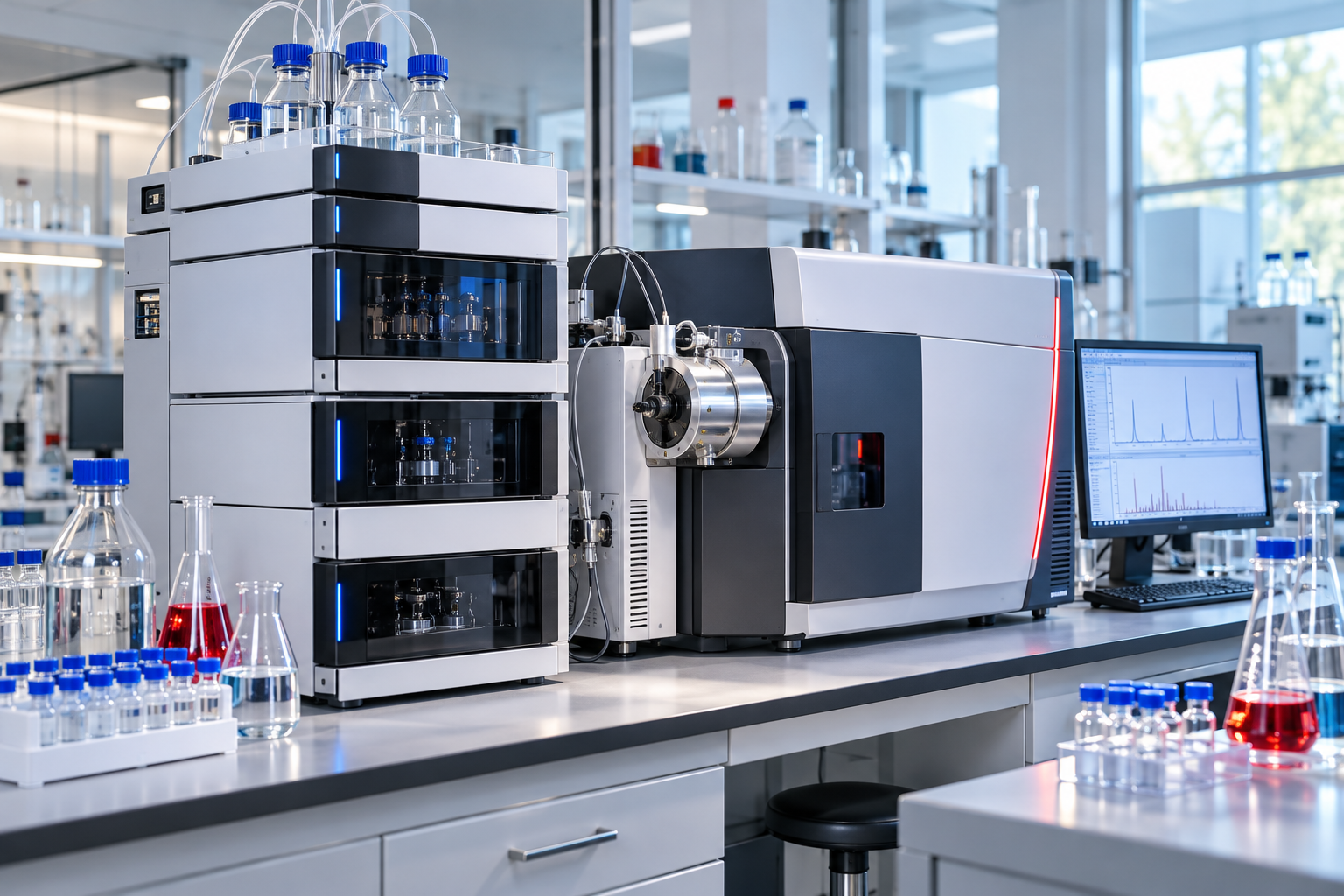
In structural biology and peptide synthesis, experimental reproducibility hinges upon chemical fidelity. When evaluating synthetic peptides such as AOD-9604—a modified hexadecapeptide derived from the C-terminal region of human growth hormone (Tyr-hGH177-191)—laboratories must employ stringent analytical methodologies to confirm identity, net peptide content, and chromatographic purity. Because minor deviations during solid-phase peptide synthesis (SPPS) can generate deletion sequences or diastereomers, analytical verification using high-performance liquid chromatography (HPLC) and mass spectrometry (MS) represents the gold standard for quality assurance.
Reversed-Phase HPLC: Determining Chromatographic Purity
Reversed-Phase High-Performance Liquid Chromatography (RP-HPLC) is the primary technique used to determine the chemical purity of synthetic peptide lots. In an RP-HPLC assay, the stationary phase typically comprises non-polar hydrophobic silica particles (such as C18 or C4 matrices), while the mobile phase consists of an aqueous gradient containing an organic modifier—commonly acetonitrile (ACN)—acidified with ion-pairing agents like trifluoroacetic acid (TFA).
As the sample migrates through the column, individual components elute based on their relative hydrophobicity. The peptide sequence of AOD-9604 includes an internal disulfide bridge between cysteine residues, which dictates its spatial conformation and chromatographic retention profile. High-resolution UV detection, routinely calibrated at 214 nm or 220 nm to monitor peptide backbone amide bonds, generates an elution chromatogram. Analytical laboratories assess the primary peak area relative to total integrated peak area to establish purity percentages, routinely requiring thresholds exceeding 98% for empirical investigations.
This level of chromatographic scrutiny is equally crucial when analyzing other complex synthetic compounds, such as secretagogues like GHRP-2 or short-chain telomeric regulators such as epithalon, where secondary peaks may reveal incomplete deprotection or truncated fragments.
Mass Spectrometry: Confirming Exact Molecular Weight
While HPLC measures purity by separating compounds based on retention times, it cannot independently verify chemical identity. Co-eluting impurities can occasionally mimic the target compound under specific mobile-phase conditions. Therefore, electrospray ionization mass spectrometry (ESI-MS) or matrix-assisted laser desorption/ionization time-of-flight (MALDI-TOF) mass spectrometry is paired with chromatography to confirm molecular mass.
For AOD-9604, the theoretical monoisotopic mass and average molecular weight (approximately 1815.1 Da) must match the experimentally derived mass-to-charge (m/z) ratios. In positive-ion ESI-MS, researchers observe protonated multivalent states, such as [M+2H]²⁺ and [M+3H]³⁺, which are mathematically deconvoluted to determine the exact neutral mass of the intact peptide chain. This analytical confirmation validates that the synthesized chain retains the correct primary sequence without unintended amino acid substitutions or spontaneous oxidation.
Identical spectrometry methodologies are employed across disparate peptide classes, whether evaluating regulatory neuropeptides like Oxytocin Acetate or synthetic melanocortin receptor ligands like Melanotan II, ensuring that empirical data reflect the specific molecular entity under investigation.

Interpreting the Certificate of Analysis (COA)
A comprehensive Certificate of Analysis (COA) consolidates empirical testing data into a single document that laboratory personnel must review prior to reconstituting lyophilizates. Researchers can easily cross-reference batch data using an online lab report (COA) search to verify third-party analytical results. Key parameters detailed within a thorough COA include:
- Assay Purity (RP-HPLC): Expressed as a percentage, reflecting the proportion of the target compound relative to total detectable peaks.
- Molecular Weight Confirmation (ESI/MS): Demonstration that the observed mass aligns with theoretical stoichiometric calculations within acceptable instrumentation tolerances.
- Physical Appearance: Confirmation of a sterile, homogeneous, white lyophilized cake or powder free of visible contaminants.
- Solubility Profile: Verification of complete dissolution in laboratory-grade diluents such as bacteriostatic water or sterile saline.
- Net Peptide Content vs. Total Mass: Differentiating between actual peptide mass and residual counter-ions (such as acetate or TFA salts) and moisture, which is critical for preparing exact molar concentrations.
Standardizing these analytical metrics is vital across all research protocols, whether investigating regulatory heptapeptides like Selank or tripeptide neuroprotective models involving pinealon.
Global Logistics and Batch Consistency
Reliable analytical verification must be paired with dependable transport logistics to ensure that verified peptides arrive intact at institutions worldwide. Cold-chain stability and climate-controlled dispatch are critical for maintaining peptide integrity. Academic facilities and independent researchers ordering research peptides delivered to Madrid receive identical high-purity standards as international teams requiring research peptides delivered to Egypt. Exploring the full research peptide catalogue allows investigators to align their laboratory supply chains with verified analytical profiles across various experimental domains.
Secure Fully Verified AOD-9604 from Bio Mech Peptides
Bio Mech Peptides provides research facilities across the USA, UK, Spain, and Europe with analytical-grade reagents backed by transparent third-party testing. Each batch of AOD-9604 is subjected to rigorous RP-HPLC and mass spectrometry screening to verify chromatographic purity and structural accuracy. Equip your laboratory with dependable, high-purity research materials by ordering your analytical kits directly from Bio Mech Peptides today.
Want to take this further in the lab? You can compare Bacteriostatic Water research kits, or see delivery details for research peptides in France. All products are for laboratory research use only.
All compounds provided by Bio Mech Peptides are intended strictly for in vitro laboratory research and educational use, not for human or animal consumption.
Know someone who does lab research? Send them this page and earn a 3–30% affiliate commission based on your monthly referred sales.
Share & earn
Your personal share link
Post this link on your social media. Anyone you refer who places a paid order earns you a single-use 20% discount code through our referral program — it cannot be combined with another discount that is already active.
https://biomechpeptides.comA fresh code is generated every time this page loads, so each share is tracked separately.
Research disclaimer
This article is published for educational and scientific information purposes only. It does not constitute medical, veterinary, pharmaceutical, or professional advice and should not be used to diagnose, treat, cure, or prevent any condition. Bio Mech Peptides sells laboratory research materials only. Nothing on this site is a medicine, supplement, food or cosmetic, and nothing is sold for use in people or animals, whether to diagnose, treat or otherwise.
Related on Bio Mech Peptides
Compounds discussed in this article
AOD-9604
In stock
Epithalon
In stock
Oxytocin Acetate
In stock
View cart · For in-vitro research use only.
Reconstitution supplies (optional)
Sold separately and never added automatically. Solvent choice depends on the compound — check its COA or handling sheet before choosing.
Not sure which peptide fits your research question?
Take the 60-second Find Your Peptides quiz — it points you to the most relevant reference compounds for your area of investigation.
Start the quizMore in Research Journal
2026-05-22
BPC-157 in Tissue-Repair Research: What the Literature Shows
2026-07-18
BPC-157 vs TB-500: A Comparative Research Guide
2026-05-06
Cagrilintide: Long-Acting Amylin Analogue in Metabolic Research
2026-05-15
Epitalon: The Pineal Peptide in Longevity Research
2026-05-17
GHK-Cu: The Copper Peptide in Cosmetic and Skin-Biology Research
2026-07-15