
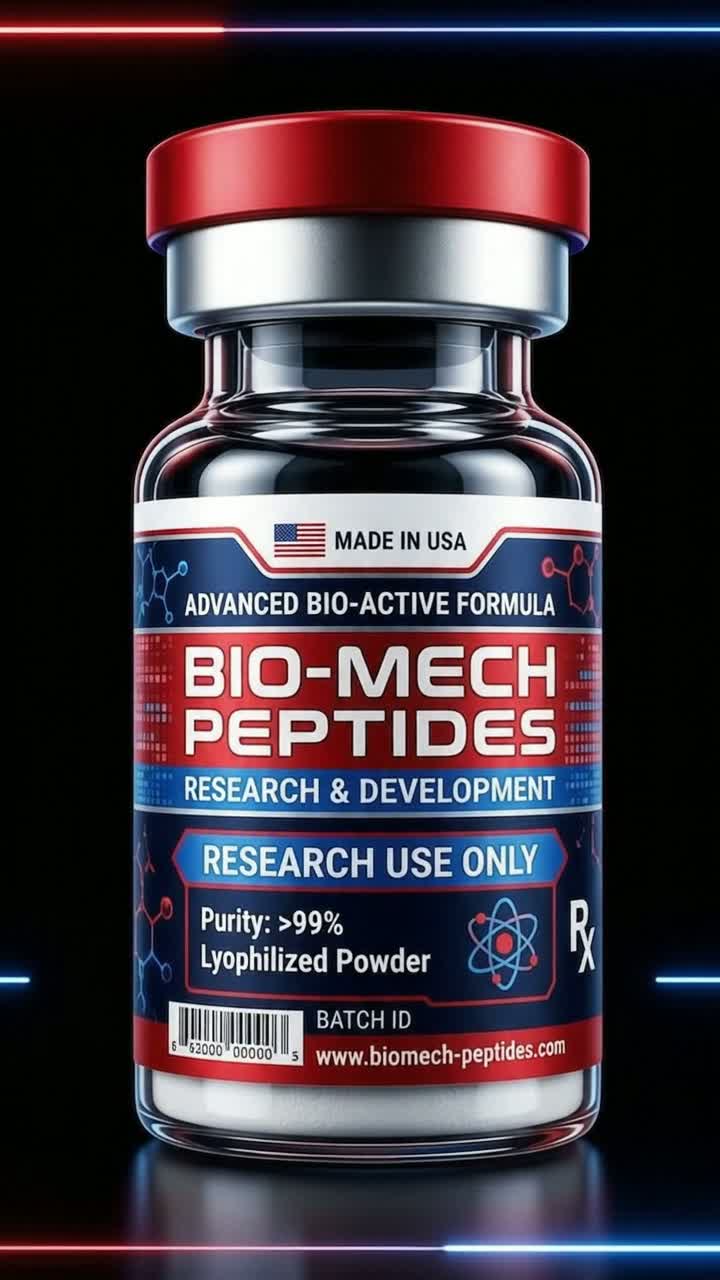
Tripeptide research compound
KPV Alpha-MSH Tripeptide | HPLC-Verified Research Grade | Bio Mech
KPV (Lysine-Proline-Valine) is the C-terminal tripeptide fragment of α-MSH, studied in laboratory research models for its modulatory effects on inflammatory signalling pathways. This guide covers what KPV is, how Bio Mech Peptides verifies every batch, and how to source vials reliably across Spain, the UK, mainland Europe and the USA.
Reading this research reference
The information below concerns the research subject, not proof of the identity or performance of a supplied material. Check the original sources and your laboratory’s requirements; product documentation must be assessed separately for the exact batch.
What KPV is and why it's studied
KPV is the three-residue C-terminal sequence of α-melanocyte-stimulating hormone (α-MSH). The full α-MSH peptide carries broad neuro-hormonal activity, but the KPV fragment retains the immunomodulatory tail without engaging melanocortin receptors that drive pigmentation. Published preclinical research has explored KPV in inflammatory bowel models, dermatological inflammation panels and mucosal-immunity assays.
Its short sequence makes KPV inexpensive to synthesise and easy to dissolve, but the same short sequence means batch identity is best confirmed by mass spectrometry rather than HPLC alone — the molecule's small size means impurity peaks can co-elute on standard reverse-phase gradients.
How Bio Mech verifies every KPV batch
No laboratory reports have yet been verified for publication against Bio Mech stock. Ask support about documentation for the exact production lot before ordering.
Janoshik Analytical is the default verification partner. Per-batch reports are published on the lab reports page and traceable to the batch number printed on every vial cap.
Storage, reconstitution and handling
Lyophilised KPV is supplied as a sterile white powder under inert atmosphere. Hold unopened vials at 2–8 °C and transfer to −20 °C only if reconstitution will not happen within 8–12 months. Reconstitute with bacteriostatic water for a two-month (60-day) in-use stability window under refrigeration; sterile water is acceptable for same-day work but not for multi-day storage.
KPV dissolves readily — solutions should be clear and colourless within seconds of gentle swirling. Cloudy reconstitution is the most common warning sign of handling error or undisclosed impurities. Most laboratories store working solutions at 1–5 mg/ml in single-use aliquots.
Buying KPV in Spain and across Europe
Bio Mech dispatches KPV from our Germany, USA or China hub with 5–18 day tracked delivery and 5–18 day Spain-wide tracked courier coverage.
No laboratory reports have yet been verified for publication against Bio Mech stock. Ask support about documentation for the exact production lot before ordering.
Buying KPV in the UK
UK research clients receive KPV via tracked dispatch from our Germany, USA or China hub in 5–18 days. VAT and customs handling are quoted transparently at checkout.
No laboratory reports have yet been verified for publication against Bio Mech stock. Ask support about documentation for the exact production lot before ordering.
Buying KPV in the United States
No laboratory reports have yet been verified for publication against Bio Mech stock. Ask support about documentation for the exact production lot before ordering.
US buyers should confirm institutional research-purchasing policy before ordering. KPV is supplied strictly for research use only and not for human consumption.
KPV vs BPC-157 in inflammation research panels
Researchers building inflammation-focused panels often include both KPV and BPC-157. The two molecules sit in distinct mechanistic lanes — KPV operates through the α-MSH immunomodulatory tail while BPC-157 is a 15-residue fragment of a gastric protective protein with a separate set of regenerative endpoints in preclinical work.
Stocking both from the same supplier keeps COA formatting, packaging and reconstitution protocols consistent across the panel and simplifies cross-experiment troubleshooting.
Quality signals to demand from a KPV supplier
An honest KPV supplier publishes the per-batch third-party COA, names the testing laboratory, includes both HPLC and mass-spec data, and prints the batch number on the vial. Mass spec is non-negotiable on tripeptides — purity numbers from HPLC alone are not enough to confirm identity on a molecule this small.
No laboratory reports have yet been verified for publication against Bio Mech stock. Ask support about documentation for the exact production lot before ordering.
Frequently asked questions
What is KPV?+
KPV is the C-terminal tripeptide fragment of α-MSH (Lys-Pro-Val), studied for its immunomodulatory effects in laboratory inflammation models.
Is KPV safe for human use?+
Bio Mech KPV is supplied strictly for in-vitro and preclinical research. It is not approved for human consumption in any jurisdiction.
What HPLC purity should I expect?+
No laboratory reports have yet been verified for publication against Bio Mech stock. Ask support about documentation for the exact production lot before ordering.
How is KPV reconstituted?+
With bacteriostatic water for a two-month (60-day) in-use stability window. KPV dissolves readily — solutions should be clear and colourless.
Do you ship KPV to Spain?+
Yes, with 5–18 day tracked delivery and 5–18 day Spain-wide tracked dispatch.
Do you ship KPV to the UK?+
Yes — 5–18 day tracked dispatch from our Germany, USA or China hub with VAT and import handling included.
Do you ship KPV to the USA?+
Yes, with discreet tracked international dispatch in temperature-buffered packaging.
How is KPV different from BPC-157?+
KPV is a three-residue α-MSH C-terminal fragment; BPC-157 is a 15-residue gastric protein fragment. Different mechanisms, different research lanes.
Recommended next
Hand-picked links our research customers most often open after this page.
Continue your research
Order KPV on the catalogue
Transparent EUR pricing · tracked dispatch
Browse the full peptide catalogue
research-only vials with batch COAs
Lab reports & certificates of analysis
Independent third-party purity data
Book a research consultation
Free 20-minute call with the Bio Mech team
Costa del Sol delivery
Tracked delivery across Marbella & Málaga
KPV product page
BPC-157 research guide
How to read a peptide COA
Laboratory peptides reference
Storage & reconstitution guide
Reconstitution best practice
Order in 3 steps · tracked delivery
Order research peptides for your laboratory
Batch documentation is provided on request — no laboratory reports have yet been verified for publication against Bio Mech stock. Dispatch is tracked on every order; allow 5–18 business days once tracking is active. Supplied for in-vitro research use only.
- 1
Choose your compound
Browse the catalog or search for a specific reference standard.
- 2
Checkout in 2 minutes
Bank transfer or card — the full price is shown before you pay.
- 3
Tracked dispatch
Tracking on every order; 5–18 business days once tracking is active.
Most ordered this month
BPC-157
From €269.00
Ipamorelin
From €249.00
Bacteriostatic Water
From €149.00
- Research use only — not for human consumption
- Tracked delivery to the USA, UK, Europe and the Middle East
- Batch documentation available on request
Research materials · Order information
Research only
Not for human consumption
Documentation
Ask about the specific batch
Tracked parcels
5–18 business days
Tracked Delivery
5–18 business days
Pay with Wise, Revolut, Monzo, bunq or bank transfer
- Card via Wise
- Card via Revolut
- Bank Transfer