
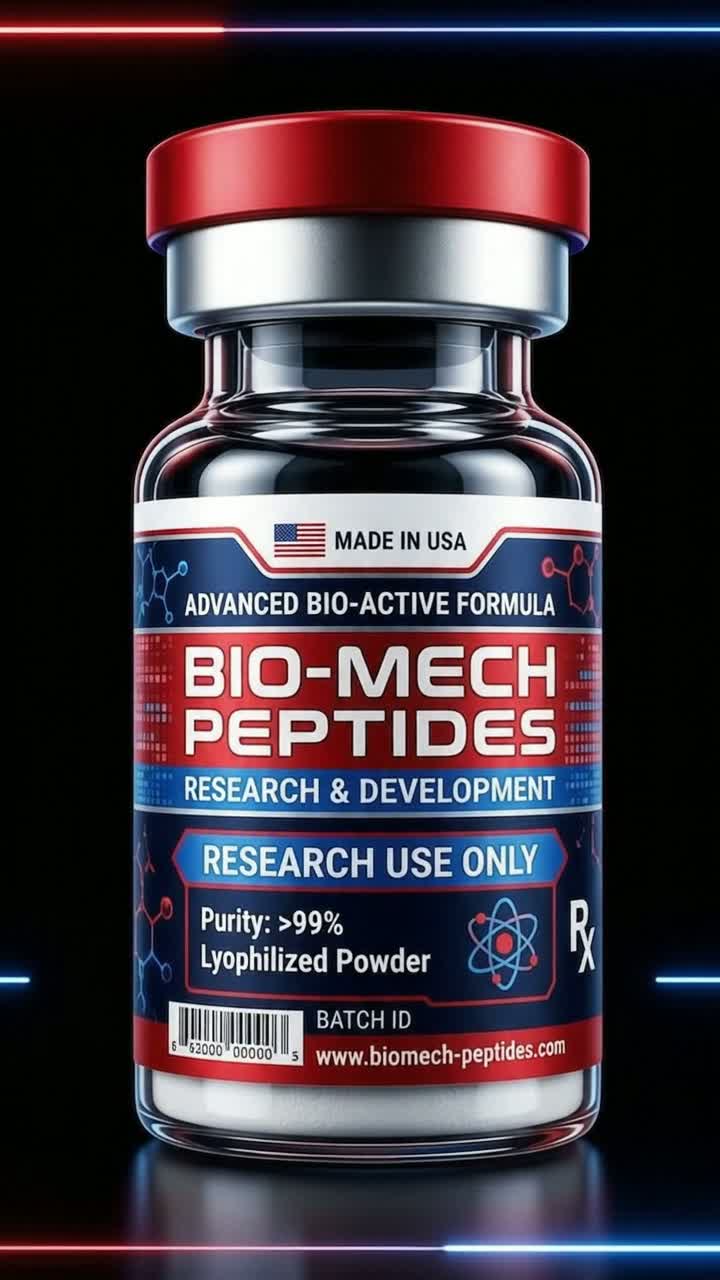
Category hub · GHRH & ghrelin-receptor class
Growth hormone secretagogue peptides
Growth hormone secretagogues fall into two mechanistic families. GHRH analogues bind the growth-hormone-releasing-hormone receptor on somatotrophs; ghrelin-receptor agonists act at GHS-R1a. Combining one from each family is the classic laboratory design, because the two pathways amplify each other rather than compete.
About this category
What researchers select for here is pulse shape, not potency alone. Short-acting secretagogues produce a sharp, physiological pulse; modified analogues with a longer plasma residence flatten that curve. Selectivity matters too — some older compounds also stimulate cortisol and prolactin, which confounds readouts in endocrine models.
All secretagogue kits ship lyophilised with a lot-specific certificate of analysis. Purity is reported as HPLC main-peak percentage and cross-checked against the expected molecular weight by mass spectrometry.
- GHRH analogues and GHS-R1a agonists in one catalogue
- Selectivity and half-life notes on every product page
- Batch COA cross-referenced to the vial cap number
- Free 20-minute scientific consultation before ordering
Pulse design: what separates the secretagogue families
Published secretagogue work distinguishes sharply between pulse shape and total exposure. Short-acting ghrelin-receptor agonists produce a discrete, physiological pulse that mirrors endogenous release timing, which is why they dominate protocols that need defined windows. Modified analogues with extended plasma residence trade that precision for convenience, and the reference literature discusses the trade-off openly rather than ranking one as universally better.
Selectivity is the other axis. Older secretagogue generations are documented to stimulate cortisol and prolactin alongside growth hormone pathways — a confound in endocrine readouts. The selective compounds avoid it, and each product page in this category states what the reference literature reports for that specific sequence rather than making a blanket claim for the class.
The classic pairing design, and how it is documented
Combining one GHRH analogue with one ghrelin-receptor agonist is the best-documented design in this category, because the two pathways act on different receptors of the same somatotroph population and amplify rather than compete. Comparison pages for the most-studied pairs set out where the documented behaviour differs, so a research design can be built on data instead of forum convention.
As with the rest of the catalogue, kits ship lyophilised with the batch certificate bundled, and the reconstitution calculator handles the diluent arithmetic for either component of a pairing.
Growth hormone secretagogue peptides in the catalogue (18)
 IpamorelinSelective GH secretagogue used in clean somatotropic axis research.
 CJC-1295 (no DAC)Short-acting GHRH analogue for pulsatile growth hormone release research.
 CJC-1295 with DACLong-acting GHRH analogue for sustained IGF-1 research models.
 SermorelinNative GHRH(1-29) fragment, baseline reference in GH research.
 TesamorelinStabilised GHRH analogue, prominent in visceral fat research models.
 HexarelinPotent GH secretagogue with cardiac receptor activity.
 MK-677Oral ghrelin mimetic for long-duration GH/IGF-1 research.
 IGF-1 LR3Long-acting IGF-1 analogue for anabolic and myogenesis research.
 GHRP-2Hexapeptide GH secretagogue for GH pulse and ghrelin research.
 GHRP-6Hexapeptide GH secretagogue with appetite-pathway research interest.
 AOD-9604hGH C-terminal fragment used in adipose lipolysis and body-composition research.
 CJC-1295 no DAC + IpamorelinGHRH + selective ghrelin-agonist research blend for pulsatile GH release studies.
 HGHReference recombinant GH used as a positive control in GH/IGF-1 axis research.
 Tesamorelin + IpamorelinGHRH analogue + selective ghrelin-agonist blend for visceral-adipose and GH-pulse studies.
 MGFShort-acting IGF-1 splice-variant peptide studied for satellite-cell activation and local muscle repair signalling.
 PEG-MGFLong-exposure PEGylated MGF analogue used where native MGF clears too rapidly for study.
 IGF-DESBinding-protein-resistant truncated IGF-1 analogue for localised IGF receptor signalling research.
 ACE-031Decoy activin receptor fusion protein used to study myostatin inhibition and muscle mass regulation.
Frequently asked questions
Why are GHRH analogues and ghrelin agonists studied together?
They act on separate receptors on the same cell population, so in published models the combined signal produces a larger release than either compound alone.
Which secretagogues are considered selective?
Selectivity means little or no measurable cortisol or prolactin response in the reference literature. Each product page states what has been reported for that compound.
What diluent is used for these peptides?
Bacteriostatic water, supplied as 10 ml × 10 sterile liquid vials. Volume per vial depends on the concentration your protocol calls for — our reconstitution calculator works it out.
Related pages
External references
Other categories
All compounds are supplied for in-vitro laboratory research use only. Nothing on this page is medical advice or a recommendation for human or veterinary use.
Order in 3 steps · tracked delivery
Order research peptides for your laboratory
Batch documentation is provided on request — no laboratory reports have yet been verified for publication against Bio Mech stock. Dispatch is tracked on every order; allow 5–18 business days once tracking is active. Supplied for in-vitro research use only.
- 1
Choose your compound
Browse the catalog or search for a specific reference standard.
- 2
Checkout in 2 minutes
Bank transfer or card — the full price is shown before you pay.
- 3
Tracked dispatch
Tracking on every order; 5–18 business days once tracking is active.
Most ordered this month
BPC-157
From €269.00
Ipamorelin
From €249.00
Bacteriostatic Water
From €149.00
- Research use only — not for human consumption
- Tracked delivery to the USA, UK, Europe and the Middle East
- Batch documentation available on request