
Hub · Comparison
BPC-157 vs TB-500: Research Comparison Guide | Bio Mech
BPC-157 and TB-500 are two of the most-discussed regenerative-research peptides. This reference compares their sequence background, proposed signalling pathways, handling and batch verification — strictly for in-vitro and educational research.
Reading this research reference
The information below concerns the research subject, not proof of the identity or performance of a supplied material. Check the original sources and your laboratory’s requirements; product documentation must be assessed separately for the exact batch.
Sequence background
Proposed mechanisms
BPC-157 is most often discussed in the angiogenesis literature — VEGFR2 signalling, nitric-oxide pathway modulation and growth-factor expression in connective-tissue research models. TB-500 is studied for actin sequestration: its central KLKKTET motif binds G-actin and is associated with cell migration and remodelling in research literature.
Why they are often paired in research
The two compounds act on different layers of tissue-remodelling research models — BPC-157 on vascular and growth-factor signalling, TB-500 on the cytoskeletal actin pool. Researchers comparing the two typically note complementary rather than overlapping pathway coverage.
Handling and storage
Both peptides ship lyophilised and are stored at 2–8°C before reconstitution. Bacteriostatic water is the standard reconstitution solvent; refrigerated in-use storage applies to both. TB-500's larger fragment size does not change standard handling practice.
Batch documentation
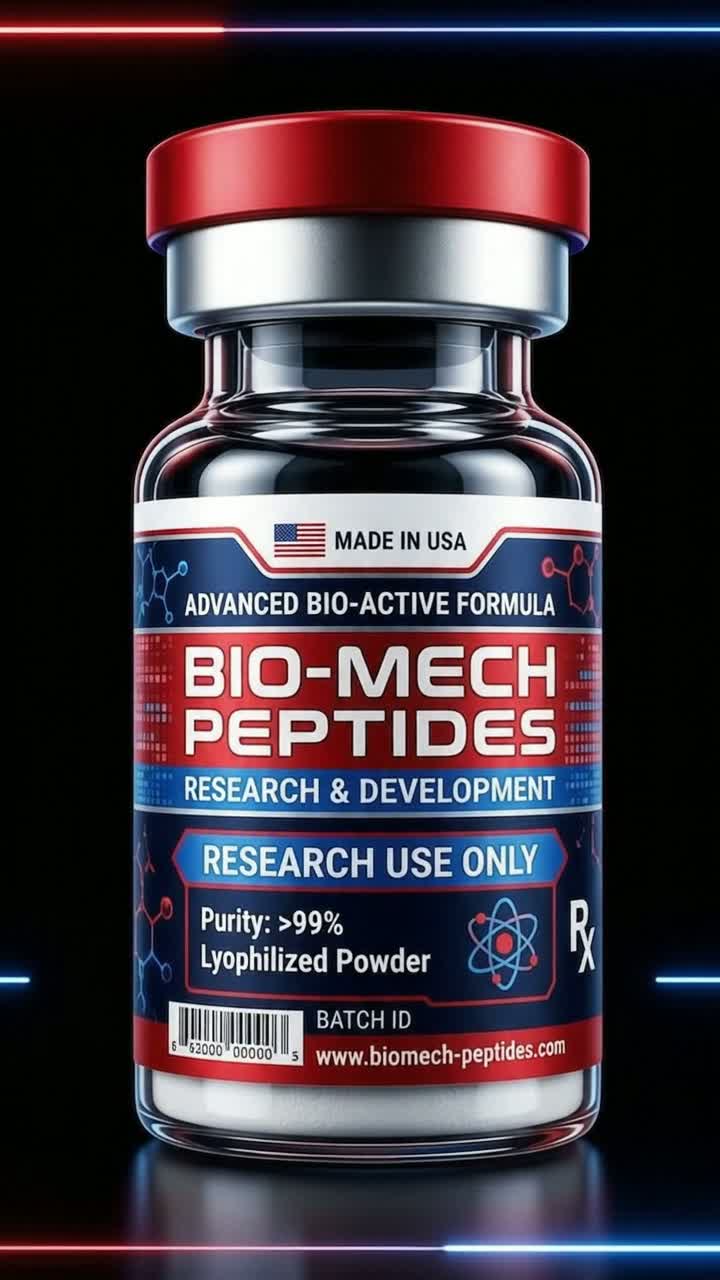
Every Bio Mech batch of BPC-157 and TB-500 ships with HPLC purity and mass-spec identity documentation, available on the lab reports page. Lot numbers on the vial label match the COA.
Choosing for a research protocol
Selection depends on the pathway the protocol targets. Angiogenesis and growth-factor endpoints typically reference BPC-157; actin-dynamics and migration endpoints typically reference TB-500. Always cross-check current literature before designing an in-vitro study.
Practical differences in the laboratory
Beyond mechanism, the two compounds differ in ways that matter at the bench. BPC-157's 15-residue sequence is short and robust: it reconstitutes readily, tolerates handling well and shows a clean, well-behaved chromatographic profile. TB-500's 17-residue fragment carries more hydrophobic character, and its solutions are somewhat more sensitive to aggregation over time — a difference that shows up in in-use stability rather than in the initial certificate.
Verification profiles differ slightly too. Both are confirmed by paired HPLC and mass spectrometry, but the interpretation differs: BPC-157's related-impurities pattern is well characterised across the literature, while TB-500 batches more often show the oxidised and truncated variants characteristic of its larger, more reactive sequence. Neither pattern is a defect — both are the ordinary chemistry of the respective molecules — but a laboratory reading the two certificates should expect the two profiles to look different.
Choosing between them for a research protocol
The choice follows the protocol's endpoint, not popularity rankings. Angiogenesis, growth-factor expression and vascular-remodelling endpoints map onto BPC-157's literature. Cell-migration, cytoskeletal dynamics and actin-sequestration endpoints map onto TB-500's. Studies of connective-tissue remodelling frequently reference both precisely because the layers are complementary — vascular supply and cellular scaffolding are different questions about the same tissue.
Where a protocol must choose a single compound, the deciding factor is usually the readout: which assay's literature has established baselines for the compound in question. A protocol measuring an endpoint with deep BPC-157 literature gains replicability from using the better-documented compound; the reverse holds for TB-500-dominant endpoints. Literature depth, in other words, is a practical selection criterion — and one the per-compound reference guides document honestly.
Frequently asked questions
Are BPC-157 and TB-500 the same thing?+
No. They are distinct synthetic peptides with different sequences, different molecular weights and different proposed signalling pathways.
Is one more 'pure' than the other?+
Purity depends on the batch, not the molecule. Both are verified by HPLC; modern research-grade material is typically reported at 99%+.
Can the two be researched together in vitro?+
Researchers often pair them precisely because the pathways differ. Any combined-use research must follow the protocol's own controls and current literature.
Where can I see the COA?+
Lot-matched COAs for BPC-157 and TB-500 are published on the lab reports page.
Which compound is more stable in solution?+
BPC-157's shorter sequence is somewhat more tolerant in solution; TB-500 solutions are more aggregation-sensitive over time. Both follow standard refrigerated in-use practice.
Do the two compounds' certificates look different?+
Yes — the impurity profiles reflect each molecule's chemistry. Expect BPC-157 traces to show a well-characterised minor-impurity pattern and TB-500 traces to include oxidised and truncated variants of its larger sequence.
BPC-157 vs TB-500 (Thymosin Beta-4) on Bio Mech
Product details, batch documentation and support for the compounds discussed above. Research use only.
Continue your research
Order in 3 steps · tracked delivery
Order research peptides for your laboratory
Batch documentation is provided on request — no laboratory reports have yet been verified for publication against Bio Mech stock. Dispatch is tracked on every order; allow 5–18 business days once tracking is active. Supplied for in-vitro research use only.
- 1
Choose your compound
Browse the catalog or search for a specific reference standard.
- 2
Checkout in 2 minutes
Bank transfer or card — the full price is shown before you pay.
- 3
Tracked dispatch
Tracking on every order; 5–18 business days once tracking is active.
Most ordered this month
BPC-157
From €269.00
Ipamorelin
From €249.00
Bacteriostatic Water
From €149.00
- Research use only — not for human consumption
- Tracked delivery to the USA, UK, Europe and the Middle East
- Batch documentation available on request
Research materials · Order information
Research only
Not for human consumption
Documentation
Ask about the specific batch
Tracked parcels
5–18 business days
Tracked Delivery
5–18 business days
Pay with Wise, Revolut, Monzo, bunq or bank transfer
- Card via Wise
- Card via Revolut
- Bank Transfer