
Hub · Growth-hormone secretagogues
CJC-1295 + Ipamorelin Synergy: Research Guide | Bio Mech
CJC-1295 and Ipamorelin are the most-studied GHRH/GHRP pairing in growth-hormone secretagogue research. This reference explains why the two analog classes are paired in laboratory protocols, the pituitary mechanism behind their additive response, and the batch documentation a research-grade buyer should expect.
Reading this research reference
The information below concerns the research subject, not proof of the identity or performance of a supplied material. Check the original sources and your laboratory’s requirements; product documentation must be assessed separately for the exact batch.
Two analog classes, one pituitary target
CJC-1295 is a GHRH (growth-hormone-releasing-hormone) analog: it binds the GHRH receptor on anterior-pituitary somatotrophs and raises intracellular cAMP, primarily increasing the amplitude of each natural GH pulse. Ipamorelin is a GHRP (growth-hormone-releasing-peptide) — a selective ghrelin/GHS-R1a agonist that acts through a phospholipase-C / IP3 pathway, primarily increasing the frequency and trough-to-peak height of GH pulses. The two receptors sit on the same cell type but use different second-messenger cascades, which is the structural reason the response is additive rather than redundant.
Why the synergy is the focus of GH-secretagogue research
In published in-vivo research models, co-administration of a GHRH analog with a GHRP produces a GH pulse that is consistently larger than either compound alone — often described in the literature as a 'synergistic' rather than 'additive' release. The mechanistic explanation usually cited is dual second-messenger activation (cAMP from GHRH-R plus IP3 from GHS-R1a) combined with GHRP-driven suppression of somatostatin tone, which removes the natural brake on GH release. The pulsatile shape of the response — rather than a flat elevation — is one reason the pairing is preferred in research models that try to approximate physiological GH kinetics.
CJC-1295 — No DAC vs With DAC in protocol design
Research-grade CJC-1295 is supplied in two forms. No-DAC (often called Modified GRF 1-29) has a half-life measured in minutes, producing a discrete pulse that pairs cleanly with Ipamorelin's own short window. With-DAC adds a drug-affinity-complex that binds serum albumin and extends the half-life to roughly six to eight days, producing sustained GHRH-R occupancy rather than a discrete pulse. Most synergy-focused research literature uses the No-DAC form precisely because the pulse shape is closer to native GH kinetics; With-DAC is more often referenced in chronic-exposure tonic-stimulation models.
Why Ipamorelin specifically — selectivity over other GHRPs
Ipamorelin is the most-selective ghrelin-receptor agonist among the commonly studied GHRPs. Compared with GHRP-2 or GHRP-6, Ipamorelin shows minimal cross-activation of cortisol, prolactin or ACTH pathways in research models — a 'clean' GH-selective profile. That selectivity is the main reason CJC-1295 + Ipamorelin became the reference research pairing rather than CJC-1295 + GHRP-6: it isolates the GH-axis response from confounding endocrine read-outs in published in-vitro and in-vivo data.
Pharmacokinetic pairing — matching the two windows
CJC-1295 No-DAC has a circulating half-life of roughly thirty minutes in research models; Ipamorelin's half-life is approximately two hours. When the two are co-administered the GHRH-R occupancy from CJC-1295 No-DAC falls inside Ipamorelin's active window, which is why research protocols generally schedule both at the same time-point. With-DAC CJC-1295 changes that picture entirely — its multi-day half-life produces a tonic GHRH-R signal that any pulse of Ipamorelin lands on top of, rather than a discrete co-administered pulse.
Handling, reconstitution and stability
Both compounds ship lyophilised and are stored at 2–8°C until reconstitution with bacteriostatic water. Ipamorelin's reconstituted in-use stability window is typically reported in the two-to-four-week range refrigerated; CJC-1295 No-DAC is similar. Aliquot before any freeze: the single most common cause of measurable potency loss in either compound is repeat freeze-thaw cycling rather than ordinary refrigerated storage.
Batch documentation on every Bio Mech vial
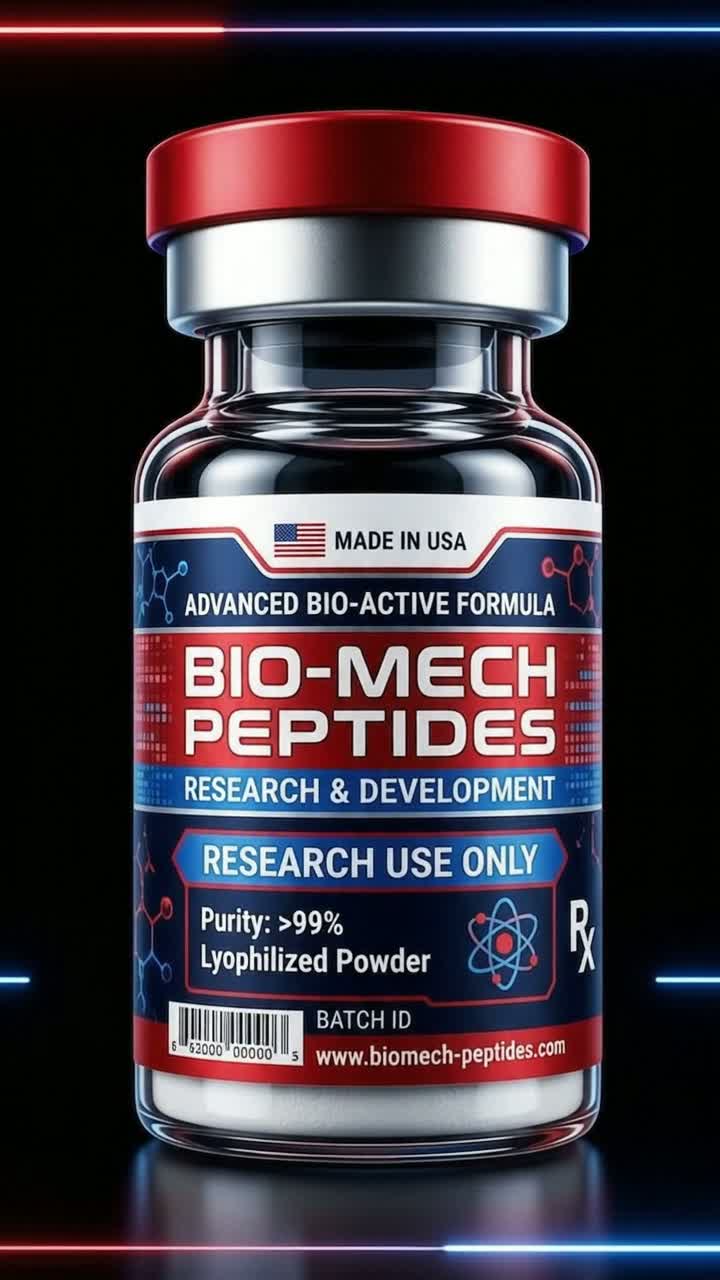
Every Bio Mech batch of CJC-1295 (No-DAC and With-DAC) and Ipamorelin ships only after independent third-party verification — Janoshik Analytical is the default verifier, with orthogonal independent laboratories used when batch chemistry calls for a second method. Minimum release specification is ≥99.0% HPLC main-peak purity with matching mass-spectrometry molecular weight. Lot-matched COAs are published on the lab reports page so research-peptide buyers can audit analytical detail before purchase.
Choosing the right pair for your research model
For pulsatile-GH-release research that mirrors physiological kinetics, the CJC-1295 No-DAC + Ipamorelin pairing is the published reference. For chronic GHRH-R tonic-exposure models — for example, long-duration metabolic or body-composition studies — CJC-1295 With-DAC paired with Ipamorelin is the more common reference. Both pairings ship from the Bio Mech library with current batch data; researchers should always cross-reference the protocol's own controls and current literature before designing an in-vitro or in-vivo study.
Frequently asked questions
Why are CJC-1295 and Ipamorelin paired in research?+
Because they act on two different pituitary receptors (GHRH-R and GHS-R1a / ghrelin) through two different second-messenger cascades. Co-administration produces a GH pulse larger than either alone, which research literature commonly describes as synergistic rather than simply additive.
What is the difference between CJC-1295 No-DAC and With-DAC?+
No-DAC has a half-life of minutes and produces a discrete GH-axis pulse. With-DAC binds serum albumin and extends the half-life to roughly six to eight days, producing tonic rather than pulsatile GHRH-R stimulation. Synergy research with Ipamorelin generally uses No-DAC.
Why Ipamorelin over GHRP-2 or GHRP-6?+
Ipamorelin is the most GH-selective ghrelin-receptor agonist of the three. It shows minimal cross-activation of cortisol, prolactin or ACTH pathways in research models, which isolates the GH-axis read-out and is why it became the reference GHRP for CJC-1295 pairing studies.
Are CJC-1295 and Ipamorelin the same compound class?+
No. CJC-1295 is a GHRH analog; Ipamorelin is a GHRP / ghrelin-receptor agonist. That mechanistic difference is exactly why the two are paired.
Where can I review the COA?+
Lot-matched COAs for CJC-1295 (No-DAC and With-DAC) and Ipamorelin are published on the lab reports page and linked from each variant in the Peptide Library.
Is any of this medical advice?+
No. All content is educational and intended for in-vitro and laboratory-research reference only. Nothing here constitutes a recommendation for human use.
Ipamorelin on Bio Mech
Product details, batch documentation and support for the compound discussed above. Research use only.
Continue your research
Order in 3 steps · tracked delivery
Order research peptides for your laboratory
Batch documentation is provided on request — no laboratory reports have yet been verified for publication against Bio Mech stock. Dispatch is tracked on every order; allow 5–18 business days once tracking is active. Supplied for in-vitro research use only.
- 1
Choose your compound
Browse the catalog or search for a specific reference standard.
- 2
Checkout in 2 minutes
Bank transfer or card — the full price is shown before you pay.
- 3
Tracked dispatch
Tracking on every order; 5–18 business days once tracking is active.
Most ordered this month
BPC-157
From €269.00
Ipamorelin
From €249.00
Bacteriostatic Water
From €149.00
- Research use only — not for human consumption
- Tracked delivery to the USA, UK, Europe and the Middle East
- Batch documentation available on request
Research materials · Order information
Research only
Not for human consumption
Documentation
Ask about the specific batch
Tracked parcels
5–18 business days
Tracked Delivery
5–18 business days
Pay with Wise, Revolut, Monzo, bunq or bank transfer
- Card via Wise
- Card via Revolut
- Bank Transfer