
·Educational reference

AOD-9604 is a synthetic peptide corresponding to the C-terminal region of human growth hormone (residues 177–191) with an added N-terminal tyrosine. Because published work on this fragment depends on knowing exactly what material was used, the first job of any laboratory is analytical: confirming identity and purity, then keeping the lyophilised material stable until the assay. This guide covers those steps for AOD-9604 reference material. It is for in-vitro research only and is not for human consumption.
What the literature has examined
Published studies have investigated the fragment in cell and animal models, focusing on lipolytic signalling in adipocytes and on whether it acts independently of the growth-hormone receptor pathway that drives somatogenic effects. Investigators have also explored effects on cartilage-related cell types. These findings describe the material used in each study; they do not certify any commercial lot.
Identity: mass spectrometry
Mass spectrometry checks whether the sample has the expected molecular mass; a matching mass alone does not establish sequence, stereochemistry or complete structural identity for the AOD-9604 sequence. Electrospray ionisation (ESI-MS) typically shows multiply charged ions that deconvolute to the parent mass; a mismatch, or significant extra species, indicates truncated sequences, oxidation or a different peptide altogether. Identity should be confirmed before purity is interpreted, because a high HPLC purity for the wrong molecule is meaningless.
Purity: reversed-phase HPLC
Reversed-phase HPLC with UV detection (commonly 214–220 nm, where the peptide bond absorbs) separates the main peptide from synthesis-related impurities such as deletion sequences. Purity is reported as the main peak's share of total integrated area. When reading a chromatogram, check the column, gradient and wavelength stated in the method, look for shoulder peaks that may hide co-eluting impurities, and remember that HPLC purity says nothing about peptide content by weight, counter-ions or residual water.
Matching the certificate to the batch
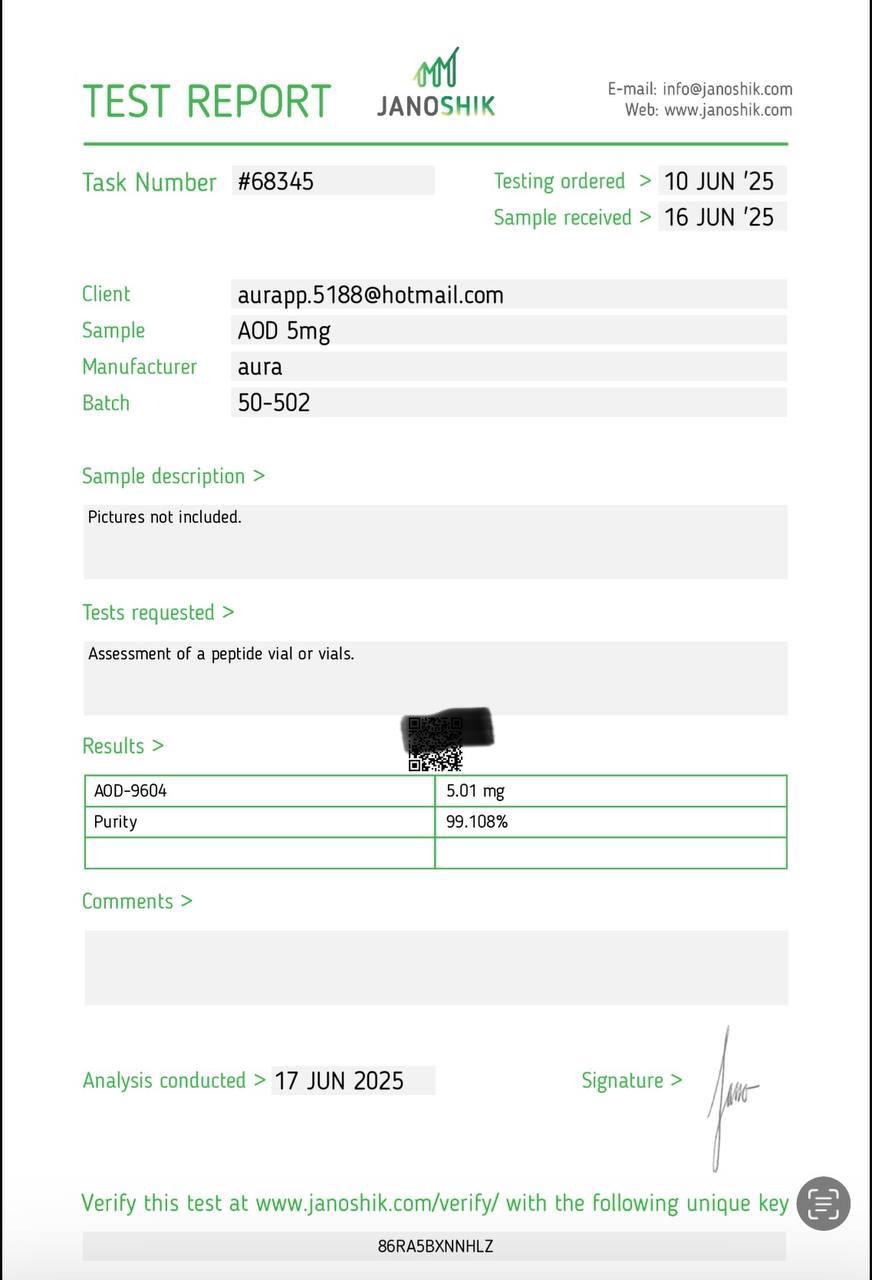
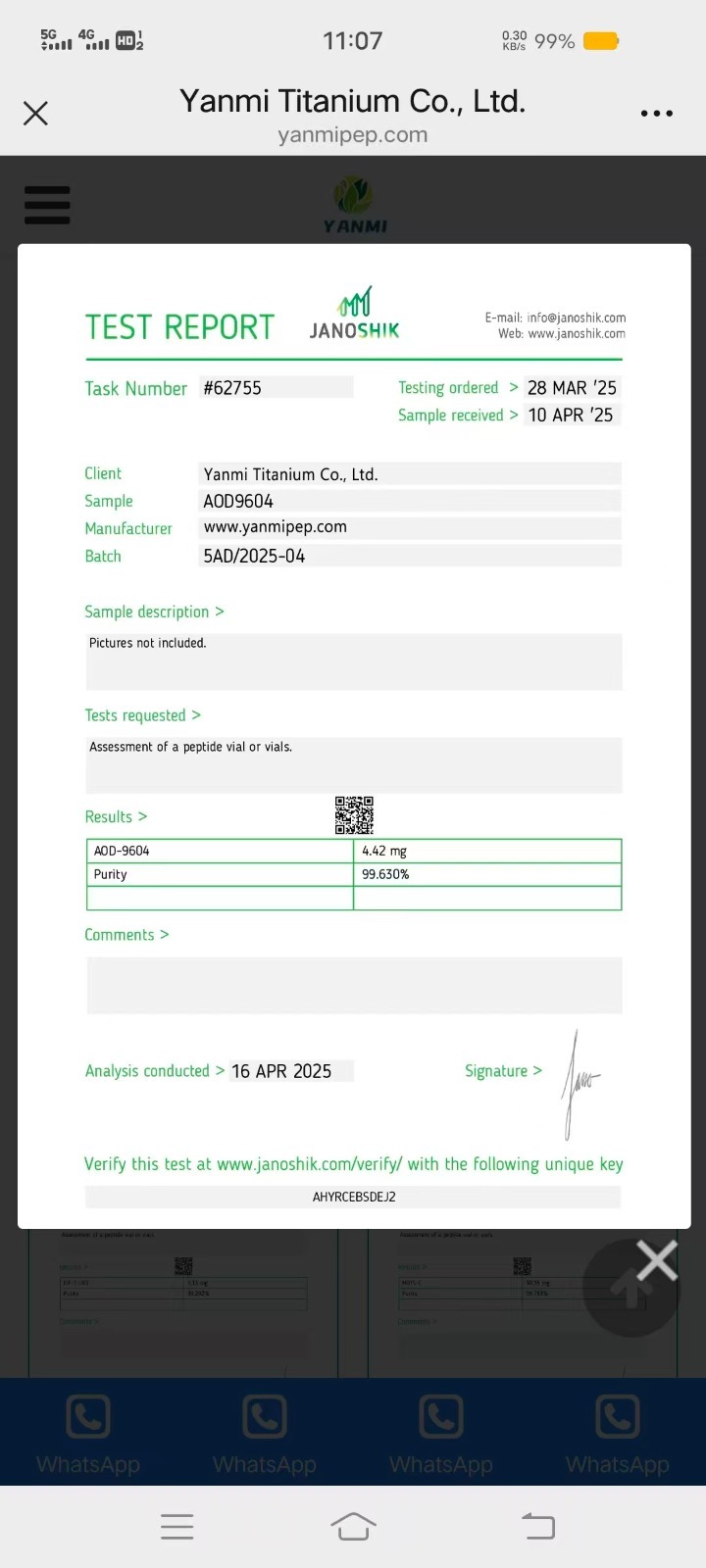
A certificate of analysis applies only to the lot it names. Compare the batch code on the report with the label on the material received, and note the testing laboratory and test date. Our public report library lists only certificates carrying a recorded batch code. If a batch code does not match, ask before relying on the report.
Storage of lyophilised material
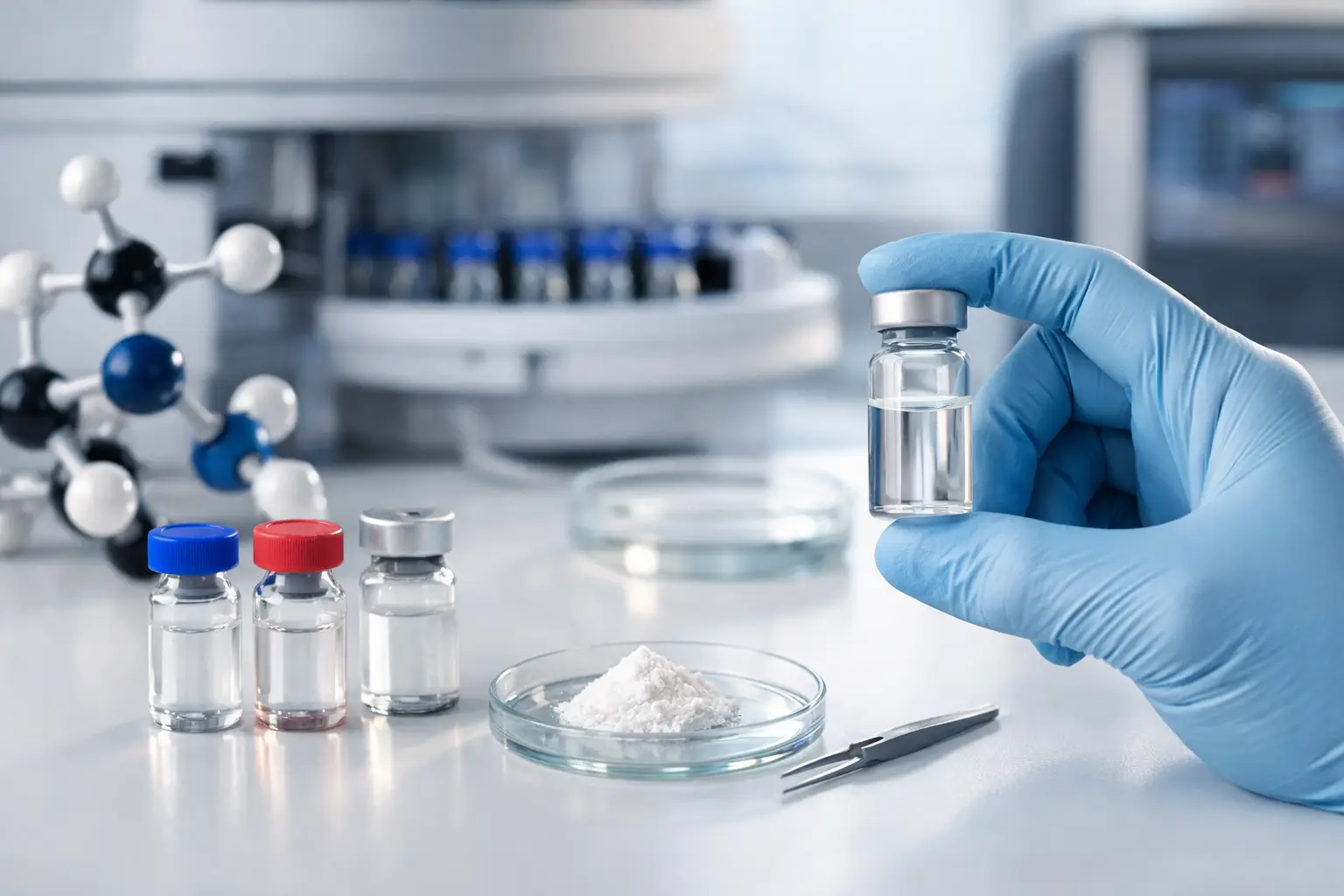
Lyophilised peptides are most stable dry, cold and dark. Common laboratory practice is to store sealed vials at −20 °C, protected from light, and to let a vial reach room temperature before opening so that condensation does not introduce moisture. Moisture accelerates hydrolysis and deamidation, and repeated temperature cycling stresses the material.
Handling once in solution
Once a peptide is dissolved for an assay, its stability falls sharply. Prepare only what the experiment needs, use sterile technique and appropriate laboratory solvents, divide stock into single-use aliquots, and avoid repeated freeze–thaw cycles. Record solvent, concentration, date and batch on every aliquot so results can be traced back to the analytical record.
A short checklist
- Confirm identity by mass spectrometry before relying on purity.
- Read the HPLC method, not just the purity figure.
- Match the certificate's batch code to the vial.
- Store sealed vials cold, dry and dark; equilibrate before opening.
- Aliquot solutions and avoid freeze–thaw cycles.
Logistics
Orders are dispatched directly by verified partners. Delivery takes 5–11 business days from when we issue the tracking number; customs and charges for each dispatch zone are set out in regional customs & dispatch.
Want to take this further in the lab? You can compare Glutathione research kits and Lemon Bottle research kits, or see delivery details for research peptides in UAE & Middle East. All products are for laboratory research use only.
References
- PubMed: published research on AOD9604
- PubMed: reversed-phase HPLC of peptides
- PubMed: lyophilised peptide stability
Research use only. Not for human consumption.
Know someone who does lab research? Send them this page and earn a 3–30% affiliate commission based on your monthly referred sales.
Share & earn
Your personal share link
Post this link on your social media. Anyone you refer who places a paid order earns you a single-use 20% discount code through our referral program — it cannot be combined with another discount that is already active.
https://biomechpeptides.comA fresh code is generated every time this page loads, so each share is tracked separately.
Research disclaimer
This article is published for educational and scientific information purposes only. It does not constitute medical, veterinary, pharmaceutical, or professional advice and should not be used to diagnose, treat, cure, or prevent any condition. Bio Mech Peptides sells laboratory research materials only. Nothing on this site is a medicine, supplement, food or cosmetic, and nothing is sold for use in people or animals, whether to diagnose, treat or otherwise.
Related on Bio Mech Peptides
Related analytical reports
These saved Janoshik reports describe their named samples, suppliers and production lots, not automatically current stock. Confirm both supplier and batch before relying on a report.
Popular research topics & products
Research topics
Popular products
Regional logistics
Compounds discussed in this article
AOD-9604
In stock
Glutathione
In stock
View cart · For in-vitro research use only.
Reconstitution supplies (optional)
Sold separately and never added automatically. Solvent choice depends on the compound — check its COA or handling sheet before choosing.
Not sure which peptide fits your research question?
Take the 60-second Find Your Peptides quiz — it points you to the most relevant reference compounds for your area of investigation.
Start the quizMore in Research Journal
2026-05-22
BPC-157 in Tissue-Repair Research: What the Literature Shows
2026-07-18
BPC-157 vs TB-500: A Comparative Research Guide
2026-05-06
Cagrilintide: Long-Acting Amylin Analogue in Metabolic Research
2026-05-15
Epitalon: The Pineal Peptide in Longevity Research
2026-05-17
GHK-Cu: The Copper Peptide in Cosmetic and Skin-Biology Research
2026-07-15