
·Educational reference
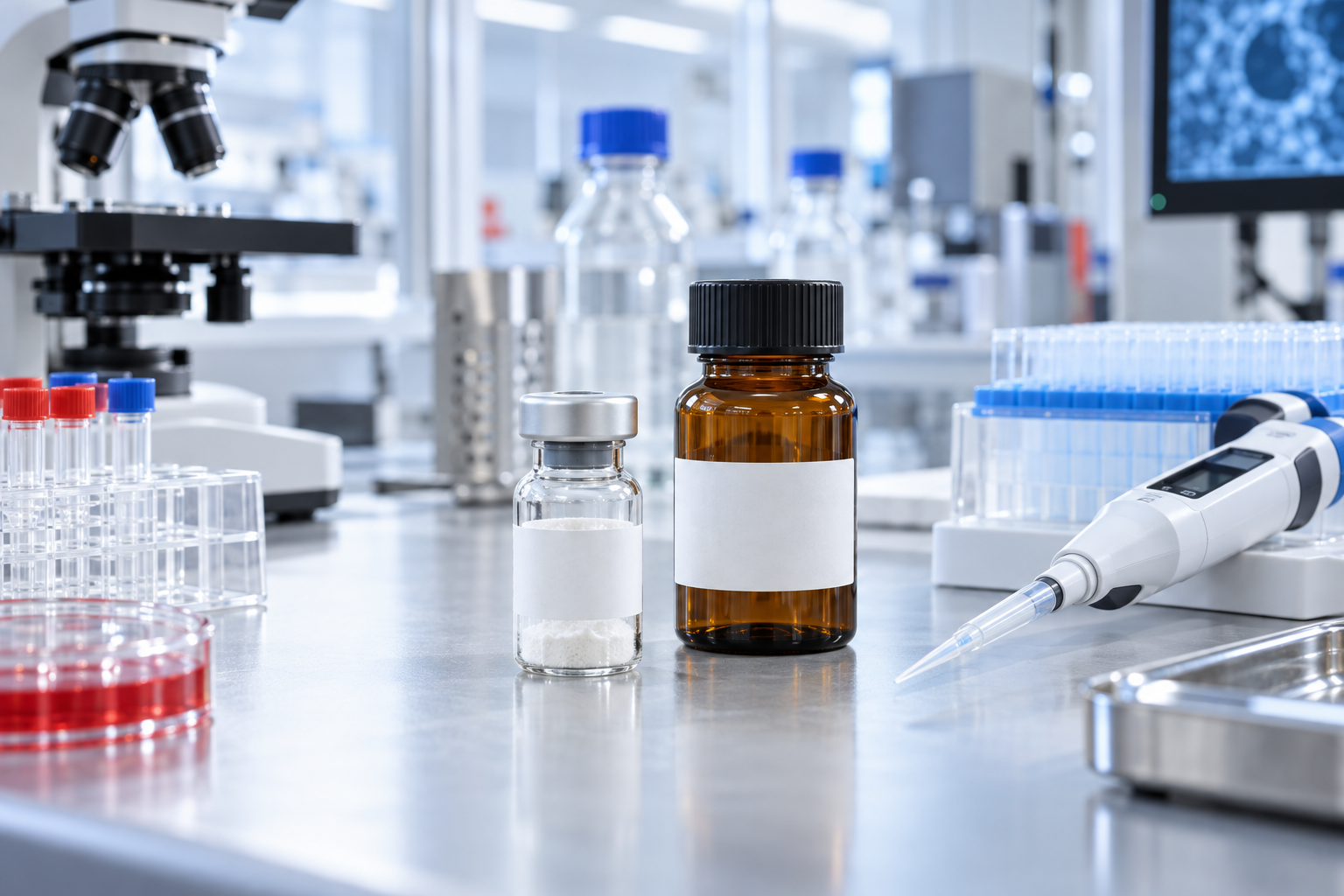
Glutathione (γ-L-glutamyl-L-cysteinylglycine) occupies a critical position in cellular biochemistry research. Consisting of glutamate, cysteine, and glycine, this endogenous tripeptide functions as a principal cellular redox buffer across diverse biological systems. In vitro models frequently evaluate reduced glutathione (GSH) to understand cellular defense against oxidative stress, mitochondrial homeostasis, and post-translational protein modification. However, the exact biochemical feature that makes glutathione fascinating to investigate—its reactive, electron-donating thiol (–SH) moiety—also makes it exceptionally vulnerable to spontaneous oxidation during storage and preparation.
Achieving reproducible experimental outcomes requires an uncompromising approach to bench protocols. Implementing meticulous lyophilised glutathione storage routines safeguards against non-enzymatic conversion to its oxidised disulphide dimer (GSSG), protecting raw material viability before any downstream assay begins.
The Biochemical Drivers of Thiol Oxidation
In its native reduced state, glutathione acts as an electron donor. When exposed to ambient conditions, atmospheric molecular oxygen, polyvalent transition metal cations (such as iron or copper), and high ambient humidity catalyse rapid auto-oxidation. Once the thiol group oxidises into a covalent disulphide linkage, the compound shifts into GSSG, radically altering its molecular kinetics and distorting quantitative data in cell-free or cell-culture investigations.
Lyophilisation (freeze-drying) substantially delays this degradative pathway by stripping out unbound bulk water. By removing moisture, scientists immobilise the molecular structure into a stable amorphous or partially crystalline cake. Nevertheless, lyophilised cakes remain intrinsically hygroscopic. Without strict containment, microscopic atmospheric moisture can rapidly infiltrate the vial, creating micro-environments of hydration where hydrolytic and oxidative processes resume.
Lyophilised Glutathione Storage Guidelines
To preserve structural integrity prior to assay integration, laboratories must enforce structured temperature controls and atmospheric separation:
- Baseline Cryogenic Storage: Sealed vials of lyophilised peptide powder should be maintained at -20°C for standard short- to medium-term investigative projects. For extended archival storage exceeding six to twelve months, maintaining samples at -80°C effectively arrests molecular drift and kinetic breakdown.
- Desiccation Control: Store original glass containers inside sealed secondary storage containers alongside active, colour-indicating silica desiccant packets. Moisture absorption degrades the physical matrix of the lyophilised cake and promotes spontaneous air oxidation.
- Minimising Thermal Cycling: Frequent opening of storage freezers induces micro-fluctuations in thermal balance. Lyophilised stocks should be consolidated in designated freezer zones where manual opening of doors is kept to a minimum.
- Light Shielding: While ambient luminescence is less immediately destructive than thermal stress, direct ultra-violet and intense visible radiation can generate free radical intermediates. Amber vials or secondary dark enclosures are standard practices for sensitive biochemicals.
Handling and Reconstitution Best Practices
The boundary between successful assays and degraded reagents often lies in the transition from storage freezer to the preparatory bench. Investigators should adopt rigorous handling practices when preparing laboratory-grade Glutathione for active testing:
1. Thermal Equilibration Before Unsealing
Never uncap a cold vial straight from a -20°C or -80°C freezer. Exposing cold glass to warm room air triggers instant condensation on both the outside and inside surfaces of the vial. Condensing moisture hydrates the dry powder before deliberate reconstitution can occur, precipitating rapid GSSG generation. Keep the vial sealed within a desiccant chamber and allow it to reach ambient bench temperature (typically 20 to 30 minutes) before puncturing or removing the stopper.
2. Solvent Selection and Degassing
Glutathione readily dissolves in sterile bacteriostatic water, deionised water, or biological buffers like phosphate-buffered saline (PBS). However, research models examining redox status must account for dissolved oxygen within the reconstitution solvent. Bubbling an inert gas such as nitrogen or argon through the liquid vehicle before reconstitution helps dislodge ambient oxygen, minimising unwanted solution-phase oxidation.
3. Aliquoting to Prevent Freeze-Thaw Loops
Once reconstituted, reduced glutathione displays significantly accelerated degradation rates compared to its dry format. Working solutions maintained at 4°C should be used promptly. If future experiments require solution stocks, immediately divide the batch into single-use, airtight aliquots and store at -80°C. Multiple freeze-thaw cycles must be rigorously avoided, as ice crystal dynamics destabilise the thiol environment.
Comparative Handling Across Peptide Classes
Different synthetic and endogenous biomolecules display distinct thermodynamic and structural sensitivities. For instance, modified sequences like synthetic Adamax vials involve complex synthetic modifications that require careful temperature maintenance to avoid chain aggregation. In contrast, pegylated peptides like researched PEG-MGF feature polyethylene glycol chains designed to modulate solubility and enzymatic vulnerability in laboratory assays, yet they remain vulnerable to shear degradation during reconstitution.
Similarly, multi-peptide research formulations such as the GLOW Blend sequence demand nuanced handling because distinct amino acid side chains react differently to changes in solvent pH and ionic strength. Non-peptide nuclear receptor research ligands, such as SLU-PP-332 powder, demonstrate distinct crystallization and solubility behaviors that differ fundamentally from short bioregulatory peptides like Thymalin fractions. Even metal-coordinating structures such as GHK-Cu copper complexes require dedicated storage to maintain active coordination states without premature dissociation. Contextualising each compound within its chemical classification ensures that storage matches the unique requirements of the molecular architecture.
Analytical Verification and Supply Integrity
Standardising bench methods yields little value if initial purity is unknown. Sourcing research compounds from verifiable suppliers provides a foundational baseline for experimental accuracy. Independent analytical testing verifies identity and purity levels across individual synthesis batches.
To support scientific rigor, researchers can freely access up-to-date analytical documentation via the Bio Mech public COA directory, examining complete analytical profiles without payment barriers or login requirements. Bio Mech Peptides functions as a trusted conduit, connecting research facilities with certified global suppliers of pure analytical compounds.
Whether institutions require peptide shipments delivered to Türkiye or dependable consignments of laboratory peptides delivered to Ethiopia, logistics pathways are built for reliability. Orders are processed efficiently, with active tracking providing dependable global delivery within 4 to 10 working days directly from supplier hubs.
Source High-Integrity Research Peptides with Bio Mech
Precision research demands pure, professionally synthesised reference compounds. Bio Mech Peptides connects university labs, independent investigators, and institutional facilities with vetted, high-purity biochemicals. Explore our thorough peptide catalogue to secure research kits featuring verifiable chemical stability, rapid global delivery, and transparent third-party testing.
Want to take this further in the lab? You can compare MGF research kits, or see delivery details for research peptides in European Union / Spain. All products are for laboratory research use only.
All compounds referenced are strictly intended for in vitro laboratory research and scientific evaluation only, and are not for human consumption, medical diagnosis, or therapeutic use.
Know someone who does lab research? Send them this page and earn a 3–30% affiliate commission based on your monthly referred sales.
Share & earn
Your personal share link
Post this link on your social media. Anyone you refer who places a paid order earns you a single-use 20% discount code through our referral program — it cannot be combined with another discount that is already active.
https://biomechpeptides.comA fresh code is generated every time this page loads, so each share is tracked separately.
Research disclaimer
This article is published for educational and scientific information purposes only. It does not constitute medical, veterinary, pharmaceutical, or professional advice and should not be used to diagnose, treat, cure, or prevent any condition. Bio Mech Peptides sells laboratory research materials only. Nothing on this site is a medicine, supplement, food or cosmetic, and nothing is sold for use in people or animals, whether to diagnose, treat or otherwise.
Related on Bio Mech Peptides
Popular research topics & products
Research topics
Popular products
Regional logistics
Compounds discussed in this article
Glutathione
In stock
View cart · For in-vitro research use only.
Reconstitution supplies (optional)
Sold separately and never added automatically. Solvent choice depends on the compound — check its COA or handling sheet before choosing.
Not sure which peptide fits your research question?
Take the 60-second Find Your Peptides quiz — it points you to the most relevant reference compounds for your area of investigation.
Start the quizMore in Research Journal
2026-05-22
BPC-157 in Tissue-Repair Research: What the Literature Shows
2026-07-18
BPC-157 vs TB-500: A Comparative Research Guide
2026-05-06
Cagrilintide: Long-Acting Amylin Analogue in Metabolic Research
2026-05-15
Epitalon: The Pineal Peptide in Longevity Research
2026-05-17
GHK-Cu: The Copper Peptide in Cosmetic and Skin-Biology Research
2026-07-15